by Nancy Jaffer | Aug 5, 2025
Mary Anne McPhail, a visionary who did so much to boost dressage in the U.S., has died at the age of 92.
“She was incredible; worked tirelessly to promote and support a sport that was not well-known,” former U.S.. Dressage Federation President Ellin Dixon Miller said on social media.
“The growth of dressage that occurred during her lifetime can, to a huge extent, be attributed to her. Mary Anne was instrumental in creating the Florida circuit. It created multiple shows at the international level, encouraged Europeans to come to us, and the best of the U.S. to unite and compete in one location.”
Mary Anne McPhail, doing what she enjoyed.
Devoted to the Dressage Foundation, where she was a volunteer committee member for more than 20 years, Mary Anne and her husband established the Mary Anne and Walter McPhail Judge Education Fund to provide support for the U.S. Dressage Federation’s judge education initiative.
“Mary Anne was one-of-a kind when it came to wisdom, kindness and generosity. Her impact on U.S. dressage has been profound throughout many years because she was never afraid to think big,” said a statement from the Dressage Foundation.
.
The U.S. Dressage Federation noted, “Mary Anne’s legacy will live on through all who knew and loved her, and through her generosity of spirit that will continue to positively impact and benefit the dressage community for years to
come.”
She also backed top riders Robert Dover and Olivia Lagoy-Weltz when they were involved in international competition.
A longtime host and executive director of the Palm Beach Dressage Derby, she lived in Loxahatchee, Fla., and Michigan, where she founded the Mary Anne McPhail Dressage Chair in Equine Sports Medicine at Michigan State University.

by Nancy Jaffer | Aug 1, 2025
So what’s next for California’s Desert International Horse Park and its former CEO Steve Hankin, who parted ways this week?
Three partners in the venture bought out Hankin and his wife, Lisa. The couple was the fourth partner in the group that six years ago purchased a long-term lease on 240 acres where the HITS Thermal show had been held previously.
The Desert International Horse Park show will continue, and there are plans for a major expansion and development in years to come at another property just down the road.

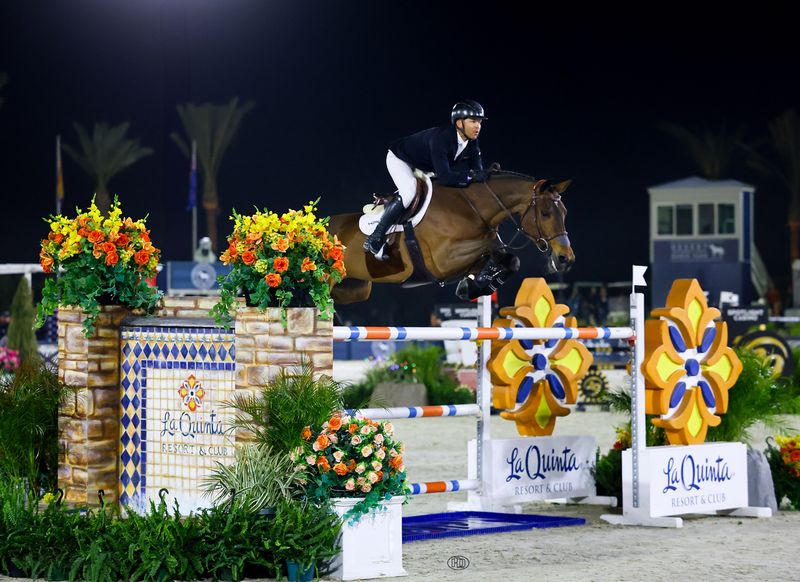
Palms and mountains provide the backdrop at Desert International Horse Park. (Photo DIHP)
The break-up raised questions, however, because the show had developed into an incredibly successful fixture, attracting a following not only in the West, but also drawing prominent riders from the East Coast and Europe.
Hankin would say only that, “Whether the partners got along or not is not relevant to the people in the industry. It’s obvious we didn’t and the partnership failed. I think it’s disappointing for the industry that it did. I think what was accomplished in the last five or six years was really remarkable.”
But the details of the break-up aren’t important to those who come to the shows, he pointed out.
“What they care about is that we built something that wasn’t there before, we raised the level of the sport and that we cared about horses,” said Hankin, mentioning he got more than 100 messages after word was out about his departure.

Riders such as Kent Farrington came from the East to compete at DIHP. (Photo DIHP)
Hankin also will be missed by Michael Stone, president of Wellington International, which hosts Florida’s Winter Equestrian Festival.
“I was very disappointed to see he was going,” said Stone.
“He was really a leader to make change and elevate the level in California, which ultimately helps everybody. The higher the level, everybody gets better. You don’t sit on your laurels.
“Having him there was definitely beneficial for the sport in general,” Stone pointed out, noting he and Hankin worked closely when Covid hit.
“We had to come up with ways of being able to get back open as fast as we could. With the EHV (Equine Herpes) outbreak, we worked on that closely too. Good to have a like-minded person on the West Coast really driving the standards out there.”
As for Hankin’s future, he will stay in both the industry and California, his home for 11 years.
“I’m 100 percent not done,” said Hankin, who plans to move on with other projects.
Meanwhile, the remaining DIHP partners, Jeremy and Christina Smith, Rob Meadows and Catherine Harvey, are pursuing a vision of their own on 640 acres that will host the horse show and a development, part of a package called Thermal Ranch. But the show will continue to be called Desert International Horse Park.

It all starts with the leadline. (Photo DIHP)
The new land is being used to grow carrots at the moment and the project is still in the approvals process with the city and county.
“We have no interest in pushing it hard until it’s being built,” Jeremy Smith said about the project, located a short canter from the present facility. The best case scenario would be for the showgrounds to open in October 2029.
“It’s a big project, but we think it’s the future of show jumping on the West Coast,” he continued, adding that it will be 30 percent larger than the current showgrounds.
“We really want to build a permanent home for the horse park that is sustainable, to own your own facility and control your own destiny,” said Smith, who has been in the crafts business and now can add the word “developer” to his resume.
“It’s $100 million to build a show and do it right,” he said, explaining the only way to make the books balance is by constructing homes, hotel rooms and commercial opportunities in and around it as well.
That means “taking a big swing and having a big enough show to make it work.”
He pointed out that while the lease on the current showgrounds is long term, “in 20 years, if it (the land) were needed for anything else, there would be no place to go because development would have happened around it. Where development happens, horses always get pushed out.”
The current facility is aging with “old infrastructure…a hard beast to keep going,” said Smith, who cited all the benefits of a purpose-built venue. The layout for stables and rings will be convenient, and an indoor arena that can host FEI World Cup qualifiers is also part of the vision.
Harvey mentioned that on the current property “The way it’s lined up, you have tractors in the same aisle ways as horses and bicyclists and golf carts We would like to line things out in a much safer way, where those two don’t overlap; have a more efficient use of space and really create a proper center where your grand prix arena and grand hunter arena are and everything else revolves around it.”
That would be “as opposed to our (current) property, it’s (the rings) at one end and the barns are at the opposite ends of the property and the grass field is even at the farthest end of the property.”
The new acreage “would give us more space to do whatever needs to be done,” Harvey said.
As Smith noted, “Being able to build a brand new modern facility that’s perfect for horses as well as guests who can actually come and watch and is safe all around, it will be a breath of fresh air and a dream for all of us.”
Having homes around a showgrounds is a model that started in Wellington, and was done in a more modular way at the World Equestrian Center in Ocala, Fla., and TerraNova, east of Sarasota, Fla.
“We’ve learned a lot over the years and we’re still learning,” said Smith, who envisions people living so close they can take a golf cart over to the venue “and socialize around the horse show instead of just going home at night.”

Socializing is a big part of DIHP’s charm. (Photo DIHP)
The current facility will still be used after the new one is built, but it can have offerings beyond hunter/jumper competition.
Options are dressage, western, low-level hunters and jumpers with no braiding, “the possibility of three day shows with lesser entry fees. How do we lower the bar to have people come in and try it out?” said Smith.
“We’ve got to make it (showing) as accessible as possible, knowing that’s it still expensive,” he commented, pointing out that growing the base is key to keep the sport strong.
The partners aren’t seeking another CEO, but they haven’t made a decision yet about who will be heading up the team at the park.
“I think Steve did a lot and I think asking anyone to do his entire job isn’t necessarily what we want to do,” Smith said.
“We’ll split that up a little bit. There’s enough for a couple of people in there. I’ll take a lot of the business end of it with the team. We all like to be involved in the business. You don’t buy a horse show for an investment, you don’t build a horse park for an investment.
“You do this because you want to be involved in it and you like the business and you enjoy this. We want it to be fun. It’s really exciting for us. But we have no intention of jumping in and running everything.”

by Nancy Jaffer | Jul 31, 2025
The man who led the Desert International Horse Park in its transformation as a California venue to be reckoned with has been bought out of the partnership that purchased the venue six years ago.
In his farewell statement Wednesday night, DIHP CEO Steve Hankin said, “it is with considerable sadness that we, Lisa (his wife) and I, are announcing the end of our involvement with the Desert International Horse Park. It took a lot of people to get to where we are today. We have an incredible team and I owe all of them an enormous thanks. That thanks extends to not only to the individuals that make the show happen in the office and at the rings that you see every day, but also the extended teams that are essential to doing what we do so well.”
There were many who wondered why Steve would want to get so involved in making the former HITS Thermal a destination for not only West Coast riders, but also East Coast and European stars.
His answer was simple: “Because it has always been about the sport.”
He cited the passion he and Lisa shared that has always been grounded in a love for horses and a desire to help build the sport, at all levels, for everyone.”
McLain Ward, a member of DIHP’s Major League Show Jumping team, paid tribute to the former CEO on social media, saying, “Steve you did an incredible job and brought the world of Showjumping to the desert!”
Because of DIHP’s success, Steve’s departure is a bit of a headscratcher. But on the same evening as his farewell, the venue announced a change in ownership as of that date.
“The current ownership group, consisting of the Smith, Meadows, and Harvey families, has completed the acquisition of the remaining ownership interest formerly held by Steve and Lisa Hankin.
“We are deeply grateful to Steve and Lisa for their vision, leadership, and unwavering commitment over the past six years. Under their guidance, DIHP has evolved from a venue in need of significant transformation into a world-class destination for equestrian sport.
“Their efforts, particularly during the unprecedented challenges of the human and horse crises of the last five years, were instrumental in establishing the Horse Park as a premier venue enjoyed by trainers, exhibitors, vendors, and spectators from around the globe.
“We thank Steve and Lisa for their dedication to our mission and their many contributions to elevating the sport on the West Coast. Their impact on DIHP and the equestrian community will be lasting.”
So why did it happen? A deeper explanation will have to wait for another day.
No new CEO was named in the ownership group’s statement, which continued, “Looking forward, the ownership group remains committed to building on this strong foundation. The current staff — who many of you know and work closely with — are already hard at work preparing for the upcoming season. We’re excited to share more updates soon, including new improvements to the facility and developments shaping the future of DIHP.”

by Nancy Jaffer | Jul 29, 2025
Cecile Hetzel Dunn was an ecumenical horsewoman, whose efforts benefited a variety of breeds, from Arabians to Friesians, Andalusians to saddlebreds.
She spent decades serving the entire horse industry, working as a licensed official and volunteering with a variety of governing bodies. Cecile was a mainstay of the U.S. Equestrian Federation’s board of directors. She served as a founding member of that panel after the organization succeeded the old American Horse Shows Association.
A recipient of the federation’s Lifetime Achievement Award, she died Saturday at the age of 89.
Cecile Hetzel Dunn and the USEF’s David O’Connor.
Cecile rode a pony on her family’s Arabian farm before she could walk and became a skilled competitor who went on to devote her life to equestrian sport and education.
After graduating from Stephens College in Missouri, she worked at Northwestern State University to develop its equestrian studies program. She returned to Stephens as a professor and director of their Equestrian Department.
Moving on to Salem International University, she developed its Equine Careers and Industry Management degree program, as well as a horsemanship teaching certification program. As a professor and coach, she inspired young equestrians by helping them set realistic goals and guiding them.
She went to her first AHSA convention in the late 1950s (she wasn’t quite sure of the year) at the posh Breakers hotel in Palm Beach.
“I thought I was in fairyland,” she said, recalling how her eyes lit up when seeing the jewels and sparkling floor-length gowns worn at the social events that once were a key part of the convention in a very different era.
Those were the days when it was “100 percent” about who you knew. For instance, she told me that after a saddlebred trainer for whom she worked wanted her to judge a horse show, he simply called a friend at the AHSA office and asked that Cecile be given a judge’s card–even though she had no training in that area.
The only question asked was whether she was 21. When her age was confirmed, Cecile got her card.
Things are different today, of course, and Cecile served17 years on USEF’s Licensed Officials Committee, among other committees that furthered the mission of the federation. She officiated for 49 years, working as a steward as well as a judge. Among the judges’ cards she held were those for Andalusian/Lusitano, Connemara, Friesian, National Show Horse, Welsh and Western.
Cecile also was a founding member of the Arabian Horse Association and served as the Region 6 Director and on various AHA committees.
She was married to the late Norman Dunn, who also was active with USEF. They are survived by two daughters, Martha Rattner and Merri Murdock-Krehl.
In lieu of flowers, Cecile’s family has requested that donations be made to the Arabian Horsemen’s Distress Fund in her memory. For information, go to: https://www.horsemensdistressfund.com/

by Nancy Jaffer | Jul 20, 2025
It wasn’t quite a wire-to-wire win, but Germany’s Richard Vogel led brilliantly most of the way to take richly deserved individual honors during the Longines FEI European Jumping Championship at Casas Novas in A Coruña, Spain on Sunday.
Never taking a misstep throughout four days of competition with the sensational United Touch S, Richie showed polished style over the demanding and brilliant technical courses produced by 2024 Paris Olympics co-designer Santiago Varela of Spain.

The new European Champion, Richard Vogel on United Touch S. (FEI Photo/Benjamin Clark)
The first day’s speed and handiness round was won by Daniel Coyle of Ireland on Legacy, but wishing to save the mare for future ventures, he dropped out. Richie’s time was 0.03 seconds slower than Daniel’s to put him second by a hair, but he moved up to first place and never left it following the Irishman’s departure.
Round after round, he and the Westfalen stallion by Untouched delivered fault-free trips over courses that demanded the utmost attention to detail, which is Richie’s specialty with United.
“I think everyone that saw it live or in front of the television sees how amazing he is,” the new European champion emphasized.
“How he performed over all days here gave such an incredible feeling. I’m very glad I could give him this medal, because he really, really deserves it.”

Sunday’s first course at the championships.
Richie didn’t hesitate to explain what contributes to his success.
“I’m just very lucky to be surrounded by special people. To name all of them would take another 20 minutes, probably half an hour. They are trying to make the best out of me there is,” he said modestly. His partner, Sophie Hinners, also was successful, finishing sixth on Iron Dames My Prins.
The competition was whittled down from 69 starters on Wednesday through to 25 starters Sunday morning, followed by a final contest for the top 12.

Sunday’s final course for the top 12.
The individual podium wound up with representatives of the three medal-winning teams.

The Longines FEI European Championships individual medalists: Scott Brash, Great Britain, silver; Richard Vogel, Germany, gold and Gilles Thomas, Belgium, bronze. (FEI Photo)
Richie contributed to Germany’s team bronze medal effort; individua silver medalist Scott Brash (Hello Folie) also was part of Great Britain’s medal of the same color, and young Gilles Thomas (Ermitage Kalone) took bronze after serving on Belgium’s gold medal team.
Scott’s ride was amazing all week, jumping out of spots where it looked as if his mare didn’t have a chance of keeping the rails in place — but Folie always did.
“She’s an incredible mare,” said Scott, mentioning that in the warm-up she felt a little tired. No matter.
“She still gives her absolute all. That shows her fighting spirit,” he noted proudly.
“She’s incredible, she’s fantastic, she knows she’s good. She’s like a small pony – she loves her food and is very greedy. She’s also quite lazy – you’d be surprised, because she’s so excitable when she goes in the ring, but she’s quite lazy in and about the place and tries to cheat out of doing work. So we have to talk to each other now and again and come to a compromise. ”
Gilles noted he had wanted a team medal in Spain, but after achieving that, “My horse felt very good, so I started to believe in another medal. Coming home with two medals is a dream. I always dreamed of having a medal in a big championship.. And now I have two,” said the man whose career took off after he was a gold medalist at both Children’s and Junior level. He has brought his 11-year-old Selle Francais stallion along for eight years.
The horses of the top three are incredible creatures, showing such an amazingly high standard that takes the sport to another level. The European Championships offered an impressive view of how the sport’s quality has evolved. With so many younger riders, such as 27-year-old Gilles and 22-year-old Seamus Hughes Kennedy of Ireland in fifth place, it demonstrated a secure standard of athletes — human and equine– for years to come.
Click here for results

by Nancy Jaffer | Jul 18, 2025
Belgium made a great podium leap from third place to take gold Friday at the Longines FEI European Jumping Championships for the first time since 2019.
The scores were so close it could have been anybody’s gold among the top three.
Britain, which had been leading since the competition began on Wednesday, slipped back to silver with two Olympic gold medalists and two championships newcomers on its side. Germany stayed steady to keep ahead of Ireland for bronze in the contest that attracted teams from 18 countries to Spain. Only the top 10 nations took part in the finals.

The Belgian team of Pieter Devos, Gilles Thomas, Nicola Philippaerts, Thibeau Spits and chef d’equipe Peter Weinberg. (FEI Photo/Benjamin Clark)
After Gilles Thomas put in a perfect trip to secure the Belgian win aboard Ermitage Kalone, the anchor rider said the victory “means a lot. From a young kid, you always watch championships, the championships are so important. To have a horse like Ermitage Kalone, I have to give him a medal. The way he was jumping today, he felt amazing.”
Gilles knew, “I could just do my thing and he will leave the fences up.”
Belgium’s chef d’equipe, Peter Weinberg, noted about his squad, “It was a quite young team this time, but they are unbelievable riders and with very good nerves, as you could see in the second round. We came from behind and the horses were jumping brilliantly.”
The route put together by 2024 Olympic co-course designer Santiago Varela and his team was imposing but delicate, with an 81-second time-allowed that proved a bit more challenging than on the other days of the competition. German veteran Marcus Ehning called it “a really, really tough course.”

The Belgian, British and German teams on the podium.
The British drop score on Thursday and Friday belonged to senior championships newcomer Matthew Sampson. He had two refusals in the triple combination on Thursday with Medoc de Toxandria and was eliminated.
A different triple on Friday also was a problem. Matthew’s horse hit the A element oxer and then refused the B segment, which was a vertical topped by a plank. It was an “oh, no!” moment, but instead of retiring, Matthew tried again and made it through. He finished on 14 penalties; 8 for the knockdown and refusal and 6 for time, but completing showed the mettle of horse and rider.
 “Medoc jumped amazing again,” said Matt.
“Obviously, we had a little hiccup the first time in the triple combination and I think that was really, honestly, coming to (due to) yesterday. I had the feeling that he really wanted to jump it, honestly, and that’s why I came back the second time, and I think he proved what an amazing horse is,” Matt continued.
“There aren’t many horses that can lose confidence like that, you know, in a certain fence, and the rider a little bit, and come back from it. But I put my leg on and said, ‘Come on boy, we can do it’ and he said, ‘Okay’. And he just jumped it.
“I think he jumped it better than you could ever want a horse to jump it the second time, so I’m disappointed with the score, but very proud of the horse. It’s a difficult situation to be in, especially in a championship like this,” he noted.
Although Olympic gold medalists Ben Maher (Dallas Vegas Batilly) and Scott Brash (Hello Folie) were fault-free, taking out both top rails on B of the double combination that was the next-to-last obstacle meant 4 faults for Donald Whitaker and Millfield Colette.
Without that error, Britain would have stayed in the lead, but it wound up with 7.96 penalties to 5.61 for Belgium.
After a clean slate Thursday, 4 faults each in the final round from 2024 Olympic individual gold medalist Christian Kukuk on Just Be Gentle and Marcus Ehning (Coolio 42) left Germany with bronze and 8.19 faults. If either of them had gone clear, Germany would have won.
Germany’s Richard Vogel on the fabulous Westfalen stallion United Touch S is in the lead for the individual title, which will be contested Sunday by the top 25 riders, some of whom, like Richie, were on teams, and some who were not. He has 0.01 penalties, while Scott has 1.08 with his Selle Francais mare, only 10 years old and doing herself proud in her first championships.
Reigning European Champion Steve Guerdat of Switzerland had a beautifully planned trip Friday, giving a real riding lesson, with Albfuehren’s Iashin Sitte, descended on his dam’s side from the famous Tinka’s Boy. Steve’s total is 1.19 penalties. The top 12 after Sunday’s first round will come back for a final crack at the title.
There are 13 riders within one fence of each other, and two fences between the top 25.
Click here for team results and here for individual standings