by Nancy Jaffer | Nov 5, 2023
I don’t usually write about horse racing these days, but I was so thrilled to watch White Abarrio win the $6 million Longines Breeders Cup Classic Saturday that I had to share my excitement.
I have followed this horse from the beginning of his career (there was just something about him that I liked) and I never lost faith in him. I always knew he would be a big winner.
Watching White Abarrio before the 2022 Haskell, Monmouth Park, when I got to see him in person.

by Nancy Jaffer | Nov 1, 2023
Even before the Pan Am Games team show jumping medals were decided this afternoon in Chile, after three perfect trips in the second round of today’s team competition, the U.S. was set to finish high enough to qualify for the 2024 Olympics in Paris. Whew!
But when the competition finished, the news was even better. The U.S. had an amazing score of four clears from McLain Ward (Contagious), Karl Cook (Caracole de la Roque), Kent Farrington (Landon) and Laura Kraut (Dorado 212) in the second round. The squad took team gold, followed by Canada’s silver medal effort; as the former leader, Brazil, dropped to bronze on a tense and exciting afternoon.

Laura Kraut, McLain Ward, Karl Cook and Kent Farrington. (Photo courtesy U.S. Equestrian)
It was quite a comeback for the U.S. under the direction of coach Robert Ridland from Tuesday’s initial speed round, where only anchor rider Laura Kraut went clean for the team, and the U.S. stood fifth.
To get a berth for Paris next year, which was Mission One in Chile, the U.S. needed to be in the top three (aside from Brazil, which already had qualified for Paris last month at the Nations Cup Final.) There would be no other chance to qualify for the U.S show jumping team, which is a regular participant at the Olympics. It was get it done at the Pan Ams or stay home next year.

The Canadian, U.S. and Brazilian teams get together on the podium at the end of the medal ceremony.
Coach Robert got it right Tuesday night when he said of today’s two-rounder, “it’s a new day for each of the teams here.”
Today, the U.S. riders were playing their A-game, as they took advantage of their last chance to make the cut for Paris.
Canada, earning team silver, has taken one of the other two places available for the Paris Games, and Mexico got the third. Mexico was fourth in the standings, but as Brazil finished third and was qualified, Mexico was able to clinch its slot.
“You know, we really needed clear rounds today or we weren’t going to be qualified for the Olympics. That’s as simple as that,” Kent said after his ride on Landon.

Kent and Landon.
Speaking about his horse, Kent mentioned, “He’s an inexperienced horse for this level of competition. I thought he showed his greenness the first day and he really rallied back today, actually over a more difficult and a real course. So thrilled with the performance, great progress for my horse and happy we got Team USA in the Olympics.”
As far as the medal, he noted, “Gold was the icing for us here.”
The gold, by the way, was the thirty-second medal U.S. equestrians have earned at the Pan Ams.
Robert pointed out, “One thing nobody has mentioned is the level of competition at the Pan American Games. The last two or three, we keep seeing a higher and higher level of competition. I think everybody saw that today.”
We’re all used to watching the Brits, the French, the Germans, the Swiss and the Irish, among others from Europe. So we have to readjust as we watch riders from countries such as Chile (which won gold in the first Pan Ams in 1951), Paraguay and Uruguay, with which we are less familiar in equestrian terms. But being a part of this competition meant so much to them; it was obvious by looking at their faces or watching their supporters cheer fervently.
“These are really strong teams out there fighting to the end,” observed Robert.
“It’s a tribute to what the Pan American Games have become. The sport has become so worldwide there isn’t this chasm between the Americas and Europe.”
Karl had a really difficult time Tuesday and was lucky to stay on after his mare ran out at a fence and started running. He had two rails in the first round today, but did well to leave all the poles in place this afternoon.

Karl Cook and Caracole de la Roque. (Photo courtesy U.S. Equestrian)
“It’s been less than a year that I’ve had the mare,” he mentioned.
“We hit a few variables this week that were unaccounted for in our prep, and that’s obviously our fault. I was so thankful for the support of my team, so we would keep chipping away at the issues and just progressively get better.” The final trip felt good, he said.
Anchor rider Laura said she was “so relieved when the three riders before me went clear,” in the second round.
“I almost enjoyed the last round,” she confided.
Reserve rider Lillie Keenan said of her teammates, “I had no part in what they achieved today,”
But Robert and the other team members agreed to differ.
“We had a team of five riders here, all interchangeable parts, and that was the whole point,” said Robert.
“It wasn’t a four-plus-one team.”
The course, which Robert called “fantastic,” was set at a maximum of 1.60 meters, compared with 1.50 meters in Tuesday’s one-round speed class. The extra height made it more of a test for some of the horses, who lacked experience at the highest levels of the sport.
Designer Marina Azevedo of Brazil–the only woman ever to have designed show jumping courses for the Pan Ams, and the only Level 4 female designer in the world–came up with a brilliant layout that did just enough to test horses, rather than discourage them, in most instances.
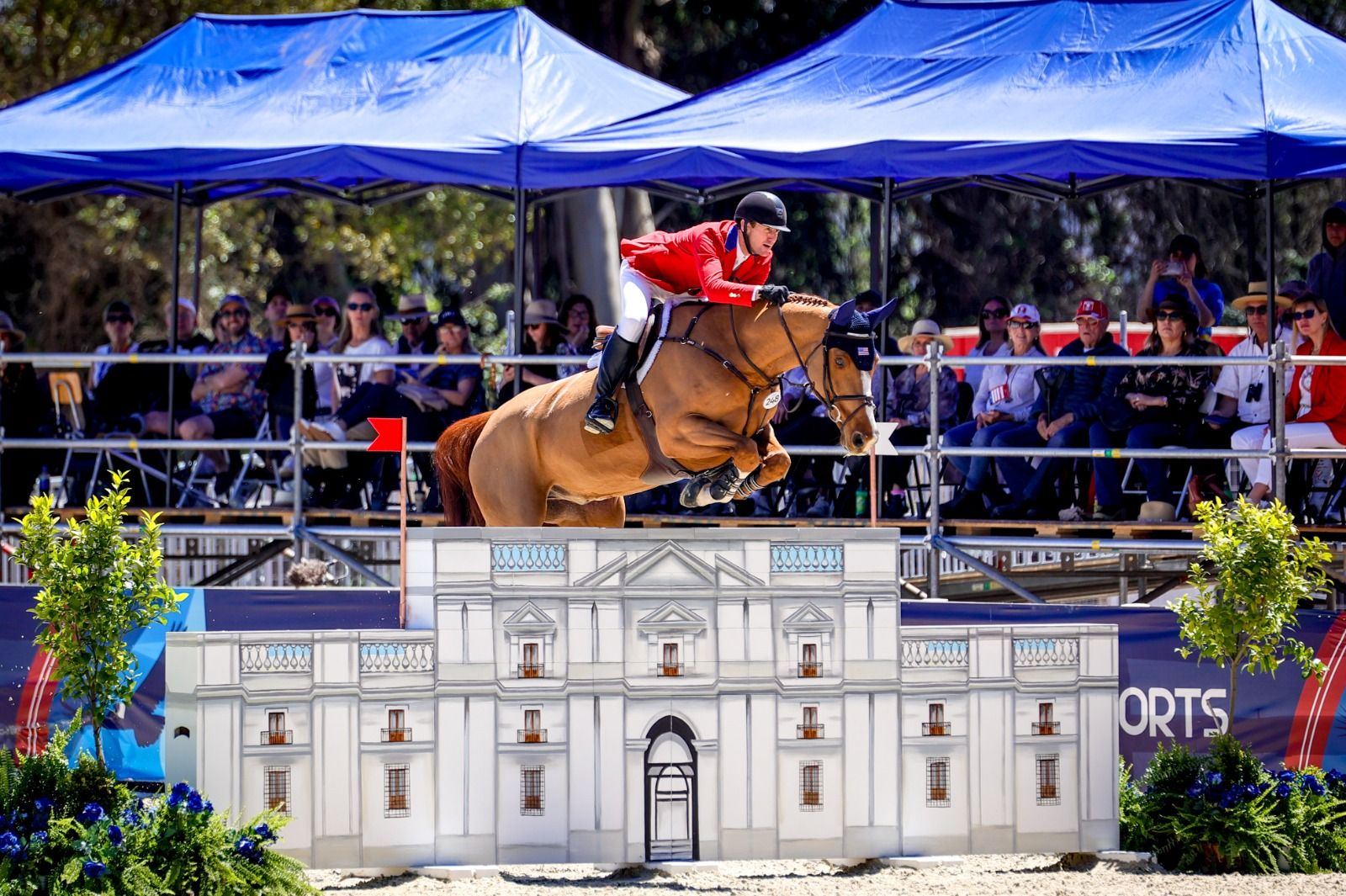
The fences were intriguing and even educational about Chile, from the bright yellow model of the country’s famous railway bridge (yellow isn’t the easiest color for horses to see, so that’s a test) to the wall painted with a Patagonian scene. My favorite was the open water jump flanked by models of Emperor penguins and large blocks of (styrofoam) ice. Chile, the longest country in the world, governs part of Antarctica, so that’s how it relates.

Laura Kraut and Dorado 212 at the railroad bridge. (Photo courtesy U.S. Equestrian)
Individual honors will be sorted out in two rounds on Friday, with 30 starters qualifying for the first round, and 20 for the medal round. McLain leads the Individual standings, followed by Laura and Brazil’s Stephan De Freitas Barcha on Chevaux Primavera Imperio Egipcio in third at the moment.
An order of go for Friday’s competition likely will be posted on Thursday, after the horse inspection. No country can field more than three riders in the individual, so Karl isn’t slated to be riding in that competition. He will, however, trot up his mare in the inspection, in case one of the other team members can’t ride for some reason, Robert said.
Ater the medal ceremony, McLain said, “As everyone knows, our `A’ goal was to qualify for the Games and to win a medal for the team and represent our country well. I thought the team rallied well and pulled it off in pretty good style today.”

McLain Ward and Contagious. (Photo courtesy U.S. Equestrian)
He cautioned, however, “The fact that it took us so long to qualify needs to bring it to our attention that we can’t rest on a good week here, that we have some work to be done to be prepared for Paris. We need to find motivation.”
Click here for team results

by Nancy Jaffer | Nov 3, 2023
Members of the U.S. gold medal team came close to sweeping the individual show jumping honors at the Pan American Games in Chile Friday, but they wound up settling for silver and bronze.

On the podium: Brazil’s Stephan de Freitas Barcha, center; Kent Farrington, USA, left, and McLain Ward, USA, right. (Photo courtesy U.S. Equestrian)
Instead, it was Stephan de Freitas Barcha, ranked number 152 in the world, who took gold by the narrowest of margins, as his fans and supporters from Brazil went nuts.

Brazil’s Stephan de Freitas Barcha had an emotional moment after clinching individual gold in the Pan Ams.
Stephan’s 8.06 penalties was the right number to edge the USA’s Kent Farrington and Landon, who had four faults and a clear today, ending with 9.64 penalties to capture silver.
The medalists had to wait before receiving their awards, however, while Canada protested a 4-fault penalty involving Amy Millar’s knockdown at the double combination on the second of two courses the horses jumped today.
The Canadian side contended the rail fell from Fence 4B only after Amy crossed the finish line, but the ground jury looked at video to determine whether that was the case. In the end, they decided the rail dropped before she finished her round, so she had to keep her 4 faults, which put her sixth with Truman.
McLain Ward of the U.S. got the bronze medal with 15.34 penalties. The U.S. now has a total of 34 medals since the Pan Am Games began in 1951.
But the delay of more than an hour before the awards ceremony meant most of the spectators (except the Brazilians!) had gone home. It was a bit of anti-climax for a wonderful event, of which Chileans should be proud.
This was the second Pan Am Games in a row where Brazil took individual gold. But defending champion Marlon Modolo Zanotelli retired in the second team jumping round on Wednesday after a knockdown and a refusal.
When he looked ahead to the individual competition, Stephan had said, “The first target was the team competition and the bronze medal was not the best feeling because we were fighting for the gold but I am in a good position for the individual.”

Pan Am Games individual show jumping gold medalist Stephan De Freitas Barcha and his magical mare. (Photo courtesy FEI)
And he turned out to be right.
“It is a dream come true,” he said after winning.
“I work every day for a day like this. It has been an unbelievable journey to get here, but now let’s celebrate and for tomorrow, let’s start to focus on Paris.”
Stephan, the two-time Brazilian national champion, was aboard Chevaux Primavera Imperio Egipcio. He had the troublesome red plank down at the last of 10 obstacles in the second individual round on the final day of competition for equestrians at the Games.
He had been clear throughout the event to that point on the 12-year-old Brazilian Sport Horse mare he has ridden for six years. He just finished within the time allowed of 61 seconds, crossing the timers in 60.51 seconds.
Stephan dedicated his win to two people close to him who have passed on.
“It is for a teacher I had since I was 15, and also my friend who I lost at the beginning of the year. I know he was with me in every round supporting me this week and this victory is for Vava, my good friend who was like a brother to me”, he stated..
McLain, who was standing first going into today’s jumping, had eight penalties with Contagious in the first of two rounds today. He got his bronze despite a rail at the next-to-last fence in the second round, as he pushed his Zweibrucker gelding to make that 61-second time allowed. They were even closer than Stephan, finishing in 60.97 seconds, just avoiding time penalties that would have taken McLain off the podium.

McLain Ward and Contagious. (Photo courtesy U.S. Equestrian)
Laura Kraut, the third U.S. rider to take part in the individual medal fray, had two rails in the second round with Dorado 212 to finish just off the podium, in fourth place with 15.39 penalties.
The individual medals were a bonus, as the team’s mission at the showgrounds in Quillota was to clinch one of three berths available for nations seeking to qualify for the 2024 Paris Olympics. That they did, finishing at the top of the leaderboard in the process.
“We came here for Wednesday,” said U.S. Coach Robert Ridland, speaking of the day his squad won team gold.
“They were brilliant on Wednesday and today. As the individual medals always are, it’s the icing on the cake.”
He was pleased with the “building partnerships” of Laura with Dorado and Kent with Landon.
Robert noted how much both Dorado and Landon have improved in the last four or five months, through he added Kent has a longer partnership with his mount than Laura does with hers.
Of Kent, Robert said, “He jumped as well as he ever has in his life all week. Some fancy riding on his part and the horse really came through.”
With the Pan Ams behind the U.S. show jumpers, “Now we know what’s next; we get ready for Paris,” emphasized Robert.
“That’s obviously our big priority. We’ll start working on that tomorrow.”
Kent said he was thrilled with the outcome of the competition and his horse, who had the only perfect trip in today’s second round, and had just a toe in the water in the first round.
“When we get into trouble, he battles his way out,” noted Kent, who started riding the 10-year-old Zangersheide gelding three years ago.

Landon gives a pair of suspicious Easter Island statues the eye as he and Kent look around the course. (Photo courtesy U.S. Equestrian)
“Big rounds today, real jumping,” he commented.
“I think that shows what the Pan Am Games has become in our sport.”
The top 27 riders started Friday morning, with 20 coming back in the afternoon over a shortened course by designer Marina Azevedo of Brazil, who has done a marvelous job.
Stephan noted, “At every championship I won in Brazil, Marina was building: In Children’s, Juniors, Young Riders and Seniors.”
The theme of the beautifully executed jumps reflected Chile’s character, heritage and history, offering a tour of the country without having to leave the arena.
The flamingos that had decorated the course since jumping began on Tuesday appropriately were gathered at the water jump, unused in the second round. That route included the one-stride double and a triple combination in a grapes and wine theme, with an oxer that was two rather tight strides from another oxer, and then one stride to a vertical.
The next-to-last fence, an oxer over a water tray, caught more than just McLain, as riders pushed to make the time, with some of them also having a mishap at the red plank that followed.
Explaining the faults there, McLain said, “The horses have jumped six rounds now (including the warm-up) and they’re tired. They were massive fences, very delicate. It takes a lot of heart for the horses to dig in deep and pull that out.”
Noting that “championships get your blood up,” he praised his horse, saying “Contagious has been brilliant,” but added, “There’s always a couple of things I can look to do better.”
Click here for results
by Nancy Jaffer | Oct 29, 2023
Lars Sederholm. the master of Watertock training center in Englan13d, died Oct. 13. The native of Sweden trained many top riders and trainers, including Yogi Breisner, Richard Meade and David O’Connor.
He is survived by his daughter, Annika.
She said, “He was truly one of a kind, in so many different ways, and had a profound effect on thousands of riders and horses all over the world. May the legacy of his teaching live on, to appreciate that wonderful animal, the horse, and to work with them in the most natural and authentic way we can.”
Those who would like to make a donation in his memory for Alzheimer’s research may do so at https://www.justgiving.com/aruk
by Nancy Jaffer | Oct 24, 2023
Jon Garner, known by many members of the public as a commentator at Canada’s Royal Winter Fair, has been named the horse show manager at the World Equestrian Center in Ocala, Fla.
A part of the show management team there since the facility opened in January 2021, he has been competition manager at Spruce Meadows in Canada and director of sport at Equestrian Canada.
Jon served in the British Army and competed internationally for Great Britain and Canada prior to his arrival at Spruce Meadows. More recently, he was the director for the FEI World Cup Finals in Omaha last spring, and held the same position in 2017.
Appointed along with Jon, Kelly McCabe has been made head show secretary at WEC Ocala. She had served as the office manager at WEC. After competing nationally as a junior and amateur, she worked in horse show offices at Blue Ribbon Horse Shows, Brownland Farm Horse Shows and Maffitt Lake Equestrian Center Horse Shows for more than 14 years.
Her horse show experience also includes serving as the feed and bedding manager for Capital Challenge Horse Show and the awards coordinator for the Pin Oak Charity Horse Show and the National Reining Breeders Classic Million Dollar Reining Horse Show.

by Nancy Jaffer | Oct 29, 2023
In his debut at the Washington International Horse Show, Rene Dittmer of Germany took an armful of special awards.
Rene Dittmer and Corsica X. (Shawn McMillen Photography)
Not only was he leading international rider and leading foreign rider; his mount, Corsica X (Conor X Corofino II), won the international jumper championship. Rene’s groom, Carolin Kagelmann, earned the international groom’s award, presented in memory of Karen Golding.
On Friday night, Rene collected victories in both the Welcome class and memorably, the costume class, dressed as a stein of beer. He said his girlfriend, Chloe Reid (whose mother, Juliet, is a former chairman of the show) selected that costume.
But he missed out on the featured $450,000 President’s Cup 5-star Longines FEI World Cup qualifier, finishing second to Katie Dinan and Brego R’n B (Namelus R X Gerbinus) in a seven-horse jump-off.
It was Katie’s first 5-star win in a decade, and she made the most of being able to go last over the course designed by Bernardo Costa Cabral, assisted by Nick Granat.
Katie, a New Yorker who has owned Brego for five years, said, “In the jump-off, he showed all of his amazing qualities. He’s got huge scope, quality, bravery, intelligence, and he tries hard. You can’t really ask for more from a horse as a rider. I think he knew he won.

President’s Cup winner Katie Dinan with Brego R’n B. (Shawn McMillen Photography)
For his part, Rene said, “The week could not have started better and kept going. I can’t be more proud of my horse.”
He speculated when he watched Alise Oken, first to go in the jump-off on Gerval, “her seven (strides) was a little short to the last and I was thinking, ‘Should I do seven?’ I caught everything quite well before, and I took the safer option. I’m still happy with my second place today. It was an amazing jump-off.”

Rene Dittmer as a beer. (Shawn McMillen Photography)
He was clocked in 34.40; Katie’s winning time was a handy 33.50.
Third place in 34.74 seconds went to Devin Ryan of Long Valley, N.J., on his longtime partner Eddie Blue (VDL Zirocco Blue X Marlon), who took him to a second place 2018 World Cup Finals finish and to team gold on the 2018 World Equestrian Games squad.
“He was jumping great tonight,” said Devin.
“He jumped the second round and even felt looser and even better. I’m very grateful that I have such a good animal, and he’s still going strong. Hopefully, it keeps on going and he has a few more years in him at this level.”
In contrast to the gray gelding’s stellar persona in the arena, “He’s a bit of a grouch in the barn,” Devin revealed, “but he loves carrots. You become his best friend as soon as you walk in the stall with a carrot for him. He has quite an attitude.”
In other action at the Prince George’s Equestrian Center in Maryland, where the show has been held for two years, Maddie Tosh won the equitation final on Daktari 38. She is the daughter of top hunter rider Hunt Tosh, who trains her with the North Run crew of Missy Clark, John Brennan and Maggie Gampfer.