by Nancy Jaffer | Nov 11, 2023
Heather Mason and Lincoln RTF won the Open Grand Prix for the third consecutive time during the US Dressage Finals Presented by Adequan® at the Kentucky Horse Park in Lexington, and wrapped up the 18-year-old horse’s career with their third victory in the Grand Prix Freestyle as well.
It is the final show together for the winners, who earned 69.203 percent in the Grand Prix to finish 0.8 percent ahead of Shelley Van Den Neste and Eyecatcher. Nora Batchelder and Faro SQF were third on 68.007 percent.
In the Saturday Freestyle, Lincoln was marked at 74.942 percent (loved the one-handed pirouette). Shelley and Nora switched places from the Grand Prix, Nora was reserve champ in the Freestyle with 74.733 percent that came close to Heather’s total; Shelley got 71.525 percent.
Of Lincoln, Heather said after the Grand Prix, “He was a little bit tricky to ride but very good and did what he needed to do.
“It was a nice last Grand Prix for him. He was getting a bit hot at times and a little bit normal at times, switching back and forth, so when he does that, I have to be really tuned into him.”
She really enjoyed his last victory pass, letting him go in an uncharacteristic way.
“I’m happy because he had two really good rides at the show, and it’s nice to go out while he’s strong,” said Mason.
“I finally let him do what he’s always wanted to do in the prize-giving, which is run. I’ve never done that before because he always gets really hot and then I’m worried about the next test, but this time I didn’t have to worry about that. He’s really been amazing.”
Heather Mason and Lincoln on their way to Grand Prix glory. (Photo by Susan J. Stickle.com)
That comment cover a lot of ground.
“He can be many different ways in a test,” the Lebanon, N.J., rider explained.
“I’ve been riding this horse for a very long time, and I have no idea what makes him one way or the other. He can start dead quiet and then rev up, or start hot and then calm down — there’s no telling. I just have to be ready to ride eight variations at all times; it’s like having eight grand prix horses in one.”
Mason bought Lincoln as a foal, then sold him. She kept in touch with the owner and ended up buying him back for $1 when the new owner had to have a hip replacement.
She has built a relationship with the quirky son of L’Andiamo, carefully managing him with longeing, patience and custom-built thigh blocks on her saddle to help withstand his lightning-fast spins.
Another New Jersey rider, Lauren Chumley of Pittstown, was a winner with Leeloo Dallas in the Open Prix St. Georges championship, the only one among 21 starters to score more than 70 percent–on a mare who is just seven years old.
“My horse is awesome. She’s just a baby but she’s absolutely amazing,” said Lauren, marked at 70.833 percent.
She warmed Leeloo Dallas up for just 15 minutes before the test and then thought, ‘Let’s go!’ and she went. She rocked on.”
Lauren’s mare is by the Ravel son Gaspard De La Nuit DG and out of a Negro dam. The professional trainer selected her from a video when she was a foal.
“I bought her because she was little and black with four white socks, and I could afford her,” said Lauren, who trains with Michael Bragdell.
“She is born, bred, and trained in America. All the horses out of her dam are so rideable. They’re easy, smart, and sensitive but not stupid.”
For all results from the show, click on this link. For just the Grand Prix Freestyle Results, click here

by Nancy Jaffer | Nov 11, 2023
For the first time, show jumping enthusiasts have the opportunity to bet on the FEI Longines World Cup qualifier class at Toronto’s Royal Winter Fair. Bookmaking firm Fitzdares, which offers odds on everything from snooker to ski jumping, is running the book at https://www.fitzdares.ca/sportsbook/SPECIALS/. Click on “equestrian” to see who’s in the running.
The only hitch is that you have to be in the Canadian province of Ontario to open an account and place a bet. Fitzdares has been operating there since the beginning of the year. The Saturday night feature at the final competition on the North American Fall Indoor Circuit offers an obvious favorite in Kent Farrington of the USA, who has been a big winner at the Royal on Creedance and seems likely to wind up as Leading Rider. But he will be aboard Greya for the World Cup, so that’s something different in the equation. The second favorite and Kent’s longtime rival is his countryman, McLain Ward on Callas.
I asked Bobby Burns, Fitzdares’ director of clubs and partnerships, how the decision to offer odds on the Royal came about.
He said that after taking bets on a pickleball tournament, the people in his office thought, “Why don’t we try it for the Royal?”
As Bobby explained it, “All we needed from the Royal was the name of the contestants and a sort of vague idea of their ability and we were able to sort of draw a book up on it.”
On the website, it’s a different style of betting than I am familiar with, but I’m not a big gambler. It’s what they call “American odds,” which means Kent was at plus 188 this afternoon, while McLain was at plus 225. The top Canadian, Tiffany Foster is at plus 400, which translates to 4-1 in the style most people in the U.S. would know. This website–https://theallstar.io/betting-odds-converter/–can translate the odds into whatever style you’re comfortable with. There’s also a way to do that on the Fitzdares site, though you have to join to use it.
I wondered if there will be more show jumping to bet on with Fitzdares, and Bobby said of the Royal, “I can’t imagine it will be the last one. It will be definitely interesting to see an appetite for the market.” By Saturday afternoon, more than $20,000 had been wagered on the class.

Kent Farrington and Creedance on their way to victory at the Royal. (Ben Radvanyi Photography)
The U.S. Equestrian Federation this year came out with a formal policy on sports betting and preventing manipulation of competition to regulate athletes when betting is involved in their discipline. Last month, I wrote about how betting is being considered for 2024 for the MARS Maryland 5-star.
Reader Sam Campbell, a native of Australia, spotted that and asked, “Does anyone remember what happened the first day the Brits introduced betting on show jumping?”
He explained, “It is ‘rumored’ a handful of top British riders got together (at Hickstead) and beat the bookies. Betting on showjumping lasted 24 hours. Circa 1969, to the best of my memory.”
I had no luck looking up this incident, so I queried Bobby about it.
He had never heard that story, but chuckled and noted, “I wouldn’t be surprised if that was completely true.”

by Nancy Jaffer | Nov 8, 2023
Part of the fun when going to major competitions involves visiting the trade fair to see what’s new and unusual. That’s how I discovered Nicola Schulten’s take on boots. What attracted me was seeing how she designed a way for spurs to in effect be buttoned onto the back of the boot.
A unique way of adding a spur to a boot. (Photo © 2023 by Nancy Jaffer)
“I was really frustrated with my spurs flopping up and down and having very tight straps over my insteps and having the circulation cut off on my feet,” she told me when we met at the MARS Maryland 5-star.
“So I decided as a shoe designer and a rider, I ought to be able to solve this problem. We are not breeding our horses the same or wearing the same clothes as we did 100 years ago. So why should we be wearing still the same shoes that we were wearing 100 years ago?”
The veteran of 30 years in the shoe business undertook “a complete rebuild of a boot with more of an athletic construction method around the front, a lot of support on the back in the heel area and a lot of shock absorption on the sole.”
There’s also a shock-absorbing footbed inside the boot “that’s really energizing to wear. It’s much much more comfortable to jump off your horse in something that actually has shock absorption built all the way through it” rather than the usual thermo-plastic rubber, she said.
Any spurs on the market fit into the pockets on the sides of the heel. There are also two holes for adjusting the height of the spur.
She moved the zipper to the inside, “so the flexing is going on in the middle of the ankle.”
The part of the boot that goes against the saddle can be faced in suede, but overall “there are three layers of leather protection between you and your stirrup leathers,” Nicola advised.
They include a lining for sheepskin from India “so it has that natural quality that Indian sheep tend to have.” Between that and the leather exterior, there is a compressed layer of pigskin.
When the boot is worn by people with cerebral palsy, “they are now able to canter because they have more support,” Nicola said, adding other customers are riders with muscles missing, hammer toes, bone spurs and bunions. It struck me that para riders might benefit from these boots.
“The more I know about what’s going on with them, the more I can build into their boots,” the native of Great Britain said about her customers.
All boots are custom and start at $2,400 for the tall boots, and $800 for paddock boots.
Her business in Grand Rapids, Mich., The Impeccable Equerry, offers a variety of interesting products, including half-chaps.
I enjoy meeting entrepreneurs with original ideas, so that’s why I wanted to share the word about Nicola’s products when I spotted them.

by Nancy Jaffer | Nov 8, 2023
Only one U.S. rider, Kent Farrington, will compete in the 22d Rolex International Jumping Riders Club Top 10 Final on December 8, during the Geneva, Switzerland, Concours Hippique International. The competition involves the 10 best show jumpers in the world, who qualify from the rankings list.
McLain Ward, number six in the world rankings, is opting out and instead going to the Desert International Horse Park in California during that time period. The IJRC worded announcement of that cryptically, saying Mclain “is unfortunately unable to travel to Europe to compete in this event.”
I was alarmed–could it be that McLain is sick, or was there a problem with his horses? But he told me heading west “was the better choice for my string of horses at this moment and keeping in mind next years busy season.” He is, of course, referring to the Paris Olympics.
McLain Ward and HH Azur on their way to victory at Geneva 2022. (Photo Ashley Neuhof/Rolex)
Irish rider Shane Sweetnam, number 11, made the top 10 as a result of McLain’s decision not to go to Geneva. At least Shane is based in the U.S.
Last year, McLain won the first leg of the Rolex Grand Slam (a different competition from the top 10) at Geneva with HH Azur, then took the second leg earlier this year in the Netherlands.
But their bid to become only the second winner of the Grand Slam ended when Annie had two of the first three fences down during the Grand Slam’s final segment at Aachen, and McLain retired from the competition. That was Annie’s last show. She had a formal retirement ceremony at the Hampton Classic in September.
Kent earned the Top 10 title in 2015 and 2019, and is the only U.S. rider ever to do so since the competition began in 2001. This year, he’s fresh off winning gold on the team with McLain at the Pan American Games, and also took individual silver at that competition in Chile. He is ranked number three in the top 10. McLain won individual bronze at the Pan Ams.
Created in 2001 by the International Jumping Riders Club, the Top 10 competition recognizes the achievements and talents of the world’s best show jumpers over the preceding year.
World number one Henrik von Eckermann of Sweden will be looking to repeat his 2022 finish at the head of the Top 10 final with King Edward. Also competing are number two, Ben Maher of Great Britain, who won the top 10 in 2021; Martin Fuchs and Steve Guerdat, both of Switzerland; Frenchmen Julien Epaillard and Simon Delestre; Max Kuhner (Austria) and Harrie Smolders (Netherlands).
IJRC President Kevin Staut noted that “the Rolex IJRC Top 10 Final is a very special class; every edition of this competition is an extraordinary event, a new and exciting experience. Thanks to its format and the understanding there is between riders and the public, it is a perfect competition.
“Winning the Rolex IJRC Top 10 is one of the most satisfying and important achievements for a rider because it marks the crowning event after a year of constructive and constant work in perfect synergy and harmony with our horses.”

by Nancy Jaffer | Nov 7, 2023
It started out as the ride of a lifetime around a top-level cross-country course at last month’s MARS Maryland Fair Hill event.
Arielle Aharoni, at age 23, was in her first 5-star competition on Dutch Times, a horse her mother, Christina, had bought as a weanling.
Now 15, Dutch had developed into a superb athlete who won show jumping classes, but whose heart was really in eventing. He finished second in June’s 4-star Long at the Bromont event in Canada, so a 5-star was the logical next step.
The Maryland course laid out by renowned Scottish designer Ian Stark had been upgraded in his third year on the job. The optimum time was tight (only one of the competitors would be able to beat the clock) and the hilly terrain posed its own challenge, That was in addition to the various tests ranging from a sunken road to the Crab Water with a beady-eyed replica of the crustacean as one of the elements.

Arielle Aharoni and Dutch Times on course at the Maryland 5-star. (Photo © 2023 by Nancy Jaffer)
When Arielle neared the end of the 28-obstacle course, Dutch continued to cover ground as if he owned it.
“It was kind of a perfect round. I never felt him get tired,” she recalled.
“He was dragging me around. There was nothing he could have done any better. He never said no.”
Then they reached what Arielle called, “the last really difficult combination,” the Fair Hill Roller-Coaster and Drop. It was so close to the end that from the next fence, the Table, number 26, “you could literally see the finish flags.”
But as Dutch negotiated the Drop, “on landing, he never put his right front down, that was pretty terrifying, it was downhill, he was at full speed on three legs,” Arielle remembered.
“It took forever to pull him up, you know, gravity; you’re going straight down a hill. I’m in distress. I’m crying, pulling him up. There were people rushing to the scene. He’s not an easy horse to deal with when he’s all amped up like that.”
She didn’t know what had happened to him—could it be a broken leg? Please no.
After she was able to stop Dutch, the people who came to help put a cast on him and loaded him into the ambulance to bring him back to stabling.
A preliminary scan showed a rupture of the superficial digital flexor tendon. Following initial treatment, Dutch went back in the trailer and headed straight for the University of Pennsylvania’s New Bolton Center, one of the country’s most highly regarded veterinary hospitals.
A later scan revealed, thankfully, that there was no involvement of the deep digital flexor tendon or suspensory ligament.
Arielle and her mother learned blunt force trauma is required in order for a tendon to rupture.
So how did it happen?
They speculated that when Dutch lost a shoe, possibly at the Foxcatcher Ditch hedge before the Roller Coaster, it might have flown off his right front hoof and hit his leg above his boot. Or he could have banged the leg on the back of a fence.
“It’s not anybody’s fault,” said Christina. “It’s just unlucky.”

Christina Aharoni makes sure Dutch gets plenty of personal attention. (Photo © 2023 by Nancy Jaffer)
The shock of the injury understandably shook Arielle.
“I was pretty much ready to quit riding–you know, I don’t have my friend,” she explained.
“I love the other horses, but this is the horse that made things happen for me. I wasn’t prepared at all to never do that (cross-country) with him again.”
But she does have other horses who need attention, and kept on going. Arielle rode two of them at the Waredaca, Md., Classic Three-Day Event and Horse Trials last month, finishing second and third in Open Preliminary on Littlebitadominic and Chumley. Now she hopes those horses can be promoted to Intermediate.
Meanwhile, Dutch’s most recent scan shows the tendon already is filling in a little bit. Christina noted the prognosis is “the nine-month standard tendon rehab.” However, the Arharonis reference the fact that Dutch bowed a tendon on his left front eight years ago when he had a different rider, and the vets didn’t have hope that he would be eventing again. He came back anyway.
At the moment, Dutch’s right leg is bandaged. He’s on hand-grazing and stall rest, with other horses in Arielle’s Branchburg, N.J., stable taking turns keeping him company in the next stall. Dutch amuses himself by tossing around his lead rope and trying to get his blanket, which is placed strategically out of his reach on the bar in front of his stall.

Hand-grazing is on Dutch Times’ schedule these days. (Photo © 2023 by Nancy Jaffer)
People have reached out with inquiries and supportive comments. Boeringer Ingelheim Animal Health sent along a case of Surpass, a non-steroidal anti-inflammatory drug that relieves pain and inflammation.
“It’s much appreciated,” said Christina.
Dutch will be going to the Aharonis’ farm in Ocala after Thanksgiving for more R&R in a friendly climate. The warm weather and limestone roads will help his healing process. After that, what he will do remains to be seen.
“He probably is not ready for retirement,” said Arielle.
“We have to hope for the best and give him something to do for the next three or four years until he starts to kind of age out.”
Possibilities include dressage, show jumping, low-level eventing or perhaps just being a mount for Christina, since she was the one who selected him all those years ago. One thing is for certain, though, said Arielle: “He’s staying with me for the rest of his life.”

by Nancy Jaffer | Nov 6, 2023
It was a saga that captured the hearts and imagination of millions–how a sweet colt made an instant connection with a teen who battled a cruelly debilitating syndrome and forged a link that carried them both to world-wide fame.
Cody Dorman, who suffered from Wolf-Hirschhorn syndrome, found joy in the fabulous career of Cody’s Wish, the colt named after him. Cody met the son of Curlin at Godolphin’s Gainsboroough Farm on a visit sponsored by the Make-A-Wish Foundation, and it was love at first sight.
Due to his condition, Cody could only communicate directly using eye-tracking to operate a tablet, but he still made himself understood to all of those around the world who followed his story.
Whenever his family could get him to the track, Cody was there, and the horse named after him was winning. Cody was his good luck charm.
That was never more evident than on Saturday in the Breeders’ Cup Dirt Mile at Santa Anita. There, the four-year-old colt battled for the win by a nose, and then withstood an objection to collect the trophy as Cody watched. It marked the end of the horse’s racing career, as he moves on to stud duty.
And with unbelievable timing, it was also the end of a heartwarming story. It somehow appears to be more than a sad coincidence that Cody himself departed a day later. He died on the way home from California to Kentucky. Cody’s Wish had been his work, and his work was done.
Michael Banahan, director of bloodstock for Godolphin USA, said the loss of the teen is especially difficult after the excitement of Breeders’ Cup weekend.
“It really does seem like divine intervention from the day Cody and Cody’s Wish first met,” he said.
“The highs and now the lows—it’s hard to comprehend. It has hit us all like a wall.”
He added about Cody’s famiIy, “I do hope they find comfort from the journey they’ve been on.”
In a statement, the family said, “We are heartbroken to share the news that our beloved Cody suffered a medical event on our trip home to Kentucky yesterday and he has passed away.
“On Saturday, Cody watched his best friend, Cody’s Wish, display his usual perseverance and toughness in winning a second Breeders’ Cup. Those are the same characteristics Cody has showed time and again for the 18 years we were blessed to have him. We have been completely amazed to experience the impact Cody has had on so many people, through the journey that this wondrous racehorse has taken us all on. From Churchill Downs, to Keeneland, to Saratoga, to Santa Anita this weekend, we could not move 20 feet without someone stopping to tell us just that.”
The statement concluded, “With Cody’s diagnosis at birth, we always knew this day would come, but we were determined to help Cody live his best life for however long we had him. Anyone who has seen him at the racetrack, especially around Cody’s Wish, understands that in many ways he taught us all how to live, always keeping a positive attitude and being more concerned about those around him than himself.”
Following the news of the teenager’s death, the Breeders’ Cup issued this statement:
“The entire Breeders’ Cup team is devastated by the news of Cody Dorman’s passing yesterday. His story captured our hearts and minds, and his strength, spirit, and determination were fittingly embodied by his namesake’s commanding performances in his honor. We send our sincere condolences to the Dormans, who gave our sport so much by welcoming us into their family.”
In lieu of flowers, the family asks for donations be made to Make-A-Wish Ohio, Kentucky & Indiana.

by Nancy Jaffer | Nov 5, 2023
“No more testing.”
That was the word which came down from the judges after the top 24 competitors had completed their rides in the second round test of the ASPCA Maclay on Sunday.
The announcement had to be anticipated by anyone who was watching Carlee McCutcheon’s flawless performance on Chacco Star in that segment, 12 hours after the class started at the National Horse Show in Lexington, Ky.
Unlike her victory in the Dover Saddlery/USEF Medal Finals last month, when she came to the top from fourteenth place, Carlee led all the way through the Maclay in the Alltech Arena at the Kentucky Horse Park. Last year, she led until the final tests, when bobbles wound up putting her fourth.
There was no mishap this time around. The victory capped off quite a fall season for Carlee, who also was second in the Platinum Performance/USEF Show Jumping Talent Search Finals East, and third in the Washington International Horse Show’s equitation championship last weekend.
“Today was really just a blessing, and I’m so grateful,” said Carlee.
Carlee McCutcheon and Chacco Star. (Photo by Shawn McMillen Photography)
“Having a partnership like I have with Chacco, is a big advantage for me, he makes me so confident and brave every time I walk in the ring,” she noted.
“I know he’s so good at the equitation; he’s very seasoned at it. He’s way better at it than I am, for sure. I think having that sort of confidence going in the ring makes a big difference for me.”
Winning at the National “means more than I think I can express. It’s so historic to be here,” said Carlee, whose name will be engraved on the iconic silver tray with the likes of those including Bill Steinkraus, Frank Chapot and Leslie Burr Howard, among so many great riders who won Olympic medals for the country.
“I’m always grateful just to qualify for this horse show,” Carlee remarked.
“It’s such a special feeling to walk into the ring here knowing the highest level of the sport has competed here and won here.”
Carlee comes from an equestrian family that breeds winners, although they are best known for reining—in which Carlee also competes. Her grandparents are Colleen and Tim McQuay; her parents are Mandy and Tom McCutcheon, all names well recognized in the horse world, no matter which branch you favor.
Carlee, who is trained by Max Amaya and T.J. O’Mara at Stonehenge in Colts Neck, N.J., also collected the Dennehy award for the best record in the fall equitation finals. She has finished her junior years with the ultimate triumph, and will be starting her professional career now.
The reserve champion was Eleanor Rudnicki, riding Waldo. She is trained by Berry Porter and North Run. Explaining what the show means to him, Berry said, “I remember watching some of these people on television and going, `Oh,it would be so cool to meet them or know them.’
“And then to have Missy Clark and John Brennan supporting me and at the ring with me is kind of cool. Never though it would happen.”
Tessa Downey, third on HH Moonshine, earned the same color ribbon as she got last year, but the University of Georgia equestrian team member stated she is “a lot prouder of the result” in 2023. She is trained by Peter Pletcher and Emily and Ken Smith.

Eleanor Rudnicki, Carlee McCutcheon and Tessa Downey with the famous trophy.
All three of the top-placing Maclay riders are from Texas, which is the first time that has happened at the country’s oldest major equitation championship, which began in 1933. (But it came close to happening last year, when the second, third and fourth-place ribbon winners were Texans.)
The officiating was being handled in a different fashion this year, with four judges: Rachel Kennedy, Wendy Peralta, Tamara Provost and Danny Robertshaw.
They were divided into two teams, complete with scribes, on each side of the ring, and the scores were done as averages.
“We spent a lot of time in Florida talking about how this should go,” said Rachel.
“I think the day went great. The kids rode great and the course was great. I can’t tell you enough good things about how today went.”
Transparency was the name of the game. The standby list was updated every 50 riders, and there was a QR Code on the livestream that people could access to find out the standings as the class went along. That innovation was enabled by Liz Soroka, who works magic behind the scenes at the show.
It took nine hours for the 226 Maclay starters in the first round to finish the beautifully landscaped course, designed by Kentucky Horse Park regular Bobby Murphy and Kevin Holowack, a Canadian who studied architecture in college. Kevin said proudly that a trainer told him the course “subtly separated” the contenders.
The challenges on the initial route included a unique first fence, a single red, white and blue pole over a base covered with artificial grass, and two one-stride double combinations with four strides between them.
A group of 24 was selected to perform on the flat, with 12 in each section.Competitors were asked to counter-canter, ride without stirrups, and lengthen stride in the sitting trot.
In the second round over 13 fences, judges included two tests; calling for the 24 riders to hand- gallop fence 4, an oxer on one side of the ring, and on the other side of the ring, put in six strides between the one-stride double of verticals and fence 10, an oxer.
As the leader following the first round, Carlee was honored with the new Hannah Serfass Memorial Award, named after a 15-year-old equestrian who died at a Florida show in April when her horse fell on her during a show jumping competition. Hannah’s score in the first round was 96.5; Eleanor’s was 94.75.
Here’s a shout-out for New Jersey: Kate Egan of Glen Gardner, who rides with Emil Spadone and Luke Olsen at Redfields, finished seventh; Caroline Signorino, who rides with Geoffrey Hesslink, was ninth.
Click here for results

by Nancy Jaffer | Nov 5, 2023
I don’t usually write about horse racing these days, but I was so thrilled to watch White Abarrio win the $6 million Longines Breeders Cup Classic Saturday that I had to share my excitement.
I have followed this horse from the beginning of his career (there was just something about him that I liked) and I never lost faith in him. I always knew he would be a big winner.
Watching White Abarrio before the 2022 Haskell, Monmouth Park, when I got to see him in person.

by Nancy Jaffer | Nov 4, 2023
Irish course designer Alan Wade has laid out show jumping fences across Europe and North America, with the FEI World Cup Finals and the FEI World Equestrian Games among the many competitions that have benefited from his style.
But until this week, he had never designed at the National Horse Show, so he was new to the Alltech Arena in Lexington, Ky., and the characteristics of that ring.
“It is quite a funny shape, but the horses seem to be jumping well. I try to build a course that’s friendly, but still gets a nice result,” said Alan, who was assisted at the show by Olympic designer Steve Stephens.
“This is quite a big ring, so it jumps a bit more like an outdoor than the indoors we have in Europe,” Alan observed.
As always seems to be the case, Alan’s efforts created classes that were both fair to the riders and exciting for the spectators.
The show’s highlight, the $226,000 4-star Longines FEI World Cup Qualifier Saturday night, drew an international field of 28, with 11 coming through to the tiebreaker.
U.S.-based Irish rider Shane Sweetnam made the most economical of turns in the jump-off with James Kann Cruz, his wife’s Irish sport horse by Kannan. He was rewarded with a clear round in the time of 33.41 seconds. His approach to the double combination showed a bit of bravery that paid off.
World Cup qualifier winner Shane Sweetnam with judge Maria de Lourdes Arrambide, National Horse Show Chairman Bill Weeks and NHS President Jennifer Burger.
“I just tried to keep it as smooth as I could, he’s a great horse, he’s always going to try to jump it,” said Shane, noting, “actually, we slipped a little bit, but it gave us room and then we just tried to keep it coming. You know, he’s giving his best all the time. He really is a show-off, he really wants to perform.
“I know with all the horses after me that I would have to be fast,” remarked Shane, who was fourth to go in the tiebreaker. His time of 33.41 seconds did the trick.

Shane Sweetnam and James Kann Cruz. (Shawn McMillen Photography)
While he’s had a good year, finishing high up in a number of grands prix, he hadn’t earned first place in one during 2023 until he succeeded with the National’s feature.
He added, “I’m delighted to have won this, especially in Kentucky,” where he has been a regular in the winner’s circle at the Kentucky Horse Park.
His whole family is with him at the show, including his wife, Ali, and daughter Olivia, who was riding in the ASPCA Maclay finals the day after her father’s victory.
Last year’s National grand prix winner, Daniel Bluman of Israel, couldn’t repeat his 2022 feat, but came close in 34.14 seconds with Gemma W.
After the class he had a comment about the turbulence in the Middle East.
“I want to send my thoughts and prayers to everyone that is currently affected, by the war,” he said, referring to the situation in Israel and Gaza.
“It’s a real tragedy and we’re praying for our resolution for the hostages to come back, and for peace in a better future.”
U.S. competitor Devin Ryan, third last weekend in the 5-star World Cup qualifier at the Washington International show, earned that placing again with his long-time partner, Eddie Blue, clear in 34.22 seconds.
“He really is quite a fighter,” Devin said of Eddie.
“You know, at home in the stables and everything he has a big personality. He’s a bit cheeky and when he goes in the ring, he just loves his job. He puts his ears forward every time he goes in the ring. He likes being on the stage.”
Interestingly, the top three in the class all rode grey horses.
Devin leads the North American League standings for next year’s World Cup finals in Saudi Arabia. He has 30 points to 28 for Shane—who had never won a Cup qualifier before—and 25 for Alise Oken.

by Nancy Jaffer | Nov 3, 2023
Members of the U.S. gold medal team came close to sweeping the individual show jumping honors at the Pan American Games in Chile Friday, but they wound up settling for silver and bronze.

On the podium: Brazil’s Stephan de Freitas Barcha, center; Kent Farrington, USA, left, and McLain Ward, USA, right. (Photo courtesy U.S. Equestrian)
Instead, it was Stephan de Freitas Barcha, ranked number 152 in the world, who took gold by the narrowest of margins, as his fans and supporters from Brazil went nuts.

Brazil’s Stephan de Freitas Barcha had an emotional moment after clinching individual gold in the Pan Ams.
Stephan’s 8.06 penalties was the right number to edge the USA’s Kent Farrington and Landon, who had four faults and a clear today, ending with 9.64 penalties to capture silver.
The medalists had to wait before receiving their awards, however, while Canada protested a 4-fault penalty involving Amy Millar’s knockdown at the double combination on the second of two courses the horses jumped today.
The Canadian side contended the rail fell from Fence 4B only after Amy crossed the finish line, but the ground jury looked at video to determine whether that was the case. In the end, they decided the rail dropped before she finished her round, so she had to keep her 4 faults, which put her sixth with Truman.
McLain Ward of the U.S. got the bronze medal with 15.34 penalties. The U.S. now has a total of 34 medals since the Pan Am Games began in 1951.
But the delay of more than an hour before the awards ceremony meant most of the spectators (except the Brazilians!) had gone home. It was a bit of anti-climax for a wonderful event, of which Chileans should be proud.
This was the second Pan Am Games in a row where Brazil took individual gold. But defending champion Marlon Modolo Zanotelli retired in the second team jumping round on Wednesday after a knockdown and a refusal.
When he looked ahead to the individual competition, Stephan had said, “The first target was the team competition and the bronze medal was not the best feeling because we were fighting for the gold but I am in a good position for the individual.”

Pan Am Games individual show jumping gold medalist Stephan De Freitas Barcha and his magical mare. (Photo courtesy FEI)
And he turned out to be right.
“It is a dream come true,” he said after winning.
“I work every day for a day like this. It has been an unbelievable journey to get here, but now let’s celebrate and for tomorrow, let’s start to focus on Paris.”
Stephan, the two-time Brazilian national champion, was aboard Chevaux Primavera Imperio Egipcio. He had the troublesome red plank down at the last of 10 obstacles in the second individual round on the final day of competition for equestrians at the Games.
He had been clear throughout the event to that point on the 12-year-old Brazilian Sport Horse mare he has ridden for six years. He just finished within the time allowed of 61 seconds, crossing the timers in 60.51 seconds.
Stephan dedicated his win to two people close to him who have passed on.
“It is for a teacher I had since I was 15, and also my friend who I lost at the beginning of the year. I know he was with me in every round supporting me this week and this victory is for Vava, my good friend who was like a brother to me”, he stated..
McLain, who was standing first going into today’s jumping, had eight penalties with Contagious in the first of two rounds today. He got his bronze despite a rail at the next-to-last fence in the second round, as he pushed his Zweibrucker gelding to make that 61-second time allowed. They were even closer than Stephan, finishing in 60.97 seconds, just avoiding time penalties that would have taken McLain off the podium.

McLain Ward and Contagious. (Photo courtesy U.S. Equestrian)
Laura Kraut, the third U.S. rider to take part in the individual medal fray, had two rails in the second round with Dorado 212 to finish just off the podium, in fourth place with 15.39 penalties.
The individual medals were a bonus, as the team’s mission at the showgrounds in Quillota was to clinch one of three berths available for nations seeking to qualify for the 2024 Paris Olympics. That they did, finishing at the top of the leaderboard in the process.
“We came here for Wednesday,” said U.S. Coach Robert Ridland, speaking of the day his squad won team gold.
“They were brilliant on Wednesday and today. As the individual medals always are, it’s the icing on the cake.”
He was pleased with the “building partnerships” of Laura with Dorado and Kent with Landon.
Robert noted how much both Dorado and Landon have improved in the last four or five months, through he added Kent has a longer partnership with his mount than Laura does with hers.
Of Kent, Robert said, “He jumped as well as he ever has in his life all week. Some fancy riding on his part and the horse really came through.”
With the Pan Ams behind the U.S. show jumpers, “Now we know what’s next; we get ready for Paris,” emphasized Robert.
“That’s obviously our big priority. We’ll start working on that tomorrow.”
Kent said he was thrilled with the outcome of the competition and his horse, who had the only perfect trip in today’s second round, and had just a toe in the water in the first round.
“When we get into trouble, he battles his way out,” noted Kent, who started riding the 10-year-old Zangersheide gelding three years ago.

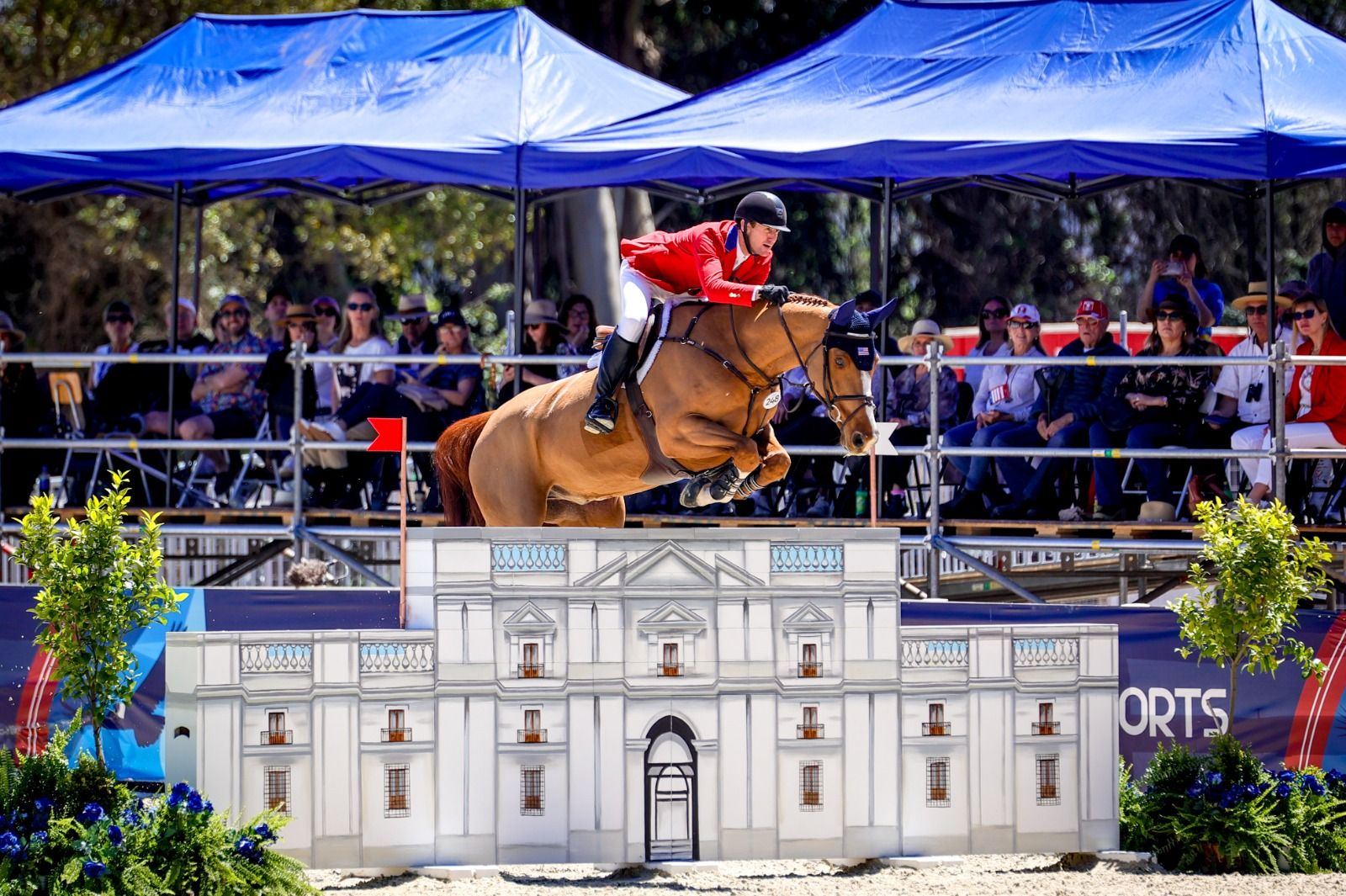
Landon gives a pair of suspicious Easter Island statues the eye as he and Kent look around the course. (Photo courtesy U.S. Equestrian)
“Big rounds today, real jumping,” he commented.
“I think that shows what the Pan Am Games has become in our sport.”
The top 27 riders started Friday morning, with 20 coming back in the afternoon over a shortened course by designer Marina Azevedo of Brazil, who has done a marvelous job.
Stephan noted, “At every championship I won in Brazil, Marina was building: In Children’s, Juniors, Young Riders and Seniors.”
The theme of the beautifully executed jumps reflected Chile’s character, heritage and history, offering a tour of the country without having to leave the arena.
The flamingos that had decorated the course since jumping began on Tuesday appropriately were gathered at the water jump, unused in the second round. That route included the one-stride double and a triple combination in a grapes and wine theme, with an oxer that was two rather tight strides from another oxer, and then one stride to a vertical.
The next-to-last fence, an oxer over a water tray, caught more than just McLain, as riders pushed to make the time, with some of them also having a mishap at the red plank that followed.
Explaining the faults there, McLain said, “The horses have jumped six rounds now (including the warm-up) and they’re tired. They were massive fences, very delicate. It takes a lot of heart for the horses to dig in deep and pull that out.”
Noting that “championships get your blood up,” he praised his horse, saying “Contagious has been brilliant,” but added, “There’s always a couple of things I can look to do better.”
Click here for results