by Nancy Jaffer | Aug 8, 2024
The biggest shocker during the equestrian portion of the Paris Olympics was the fall of world number one Henrik von Eckerman in the individual finals, when his horse, King Edward, went left, and he went right.
Sadly, Henrik had no chance to show his appreciation for King Edward in victory at the Olympics, but this photo from the 2022 World Championships expresses his love for the horse.
Here is his explanation of what happened and his feelings about the lost opportunity for himself and his special horse, known affectionately as Edi. Henrik stated:
“It ended in a way I could never have imagined. Everything felt as it should until I misjudged a distance after the open water, which resulted in a hectic jump over the Eiffel Tower plank and a very long five strides to the next oxer.
“I wanted to resettle my balance and signs weren’t clear to Edi and the situation ended in a misunderstanding and a fall in the turn,” the Swedish rider continued.
“What’s hurting the most is that these were the last Olympic Games for King Edward; his shape and spirit were there to fight for medals in the jump-off, he deserved that so much. To take that away from him is a bitter pill to swallow.
“But with time, the wound and pain will heal (he’s speaking figuratively here, not literally) and the scar that stays will hopefully make me a better rider and horseman. I’m forever grateful to you, my king, my team and my family. Lastly, I wanted to reach out to all of you who have sent their support and all the kind messages I’m receiving. It’s touching me deeply.”

by Nancy Jaffer | Aug 7, 2024
The new Olympic individual show jumping gold medalist, Christian Kukuk, is known to have been mentored by another Olympic gold medalist, Ludger Beerbaum. But it would seem that the foundation for his prowess was laid in Christian’s genes by his grandfather, Franz Kukuk, the highly respected head saddle master, or stud keeper, at the state stud in Warendorf, North Rhine-Westphalia, Germany.
“He could tell exactly from below what you were feeling above. I was very lucky to be able to see him for a few more years,” Christian, 34, said of his grandfather, who died in 2005 but could teach his grandson when the boy was in his teens.
No wonder Christian felt an instant affinity with a Westfalian horse, Checker, by Comme Il Faut 5 when he first went to see him. That was the mount who took him to the only double-clear rounds in the individual show jumping at the Paris Olympics, and from there to the top level of the podium on Tuesday. The horse is owned in part by Madeleine Winter-Schulze, who also is an owner of Wendy, Isabell Werth’s dressage team gold medal ride who was silver in the individual.
Thoms Lehmann, who is associated with an insurance firm, called attention to Christian’s background in a fascinating facebook posting./p>
He recounted that at age 14, Franz Kukuk began working at the Warendorf Landstudüt, the Westfalien state stud. The former state stallmaster, named Bresges, soon recognized the special talent of the young stud keeper and sent him to Vienna at the end of the 1950s for training at the Spanish Riding School.
When he returned, he was entrusted with a beautiful stallion, Radetzky. He was allowed to ride the horse to the Grand Prix in dressage.However, at that time, horses owned by the state were never permitted to be used in competition, even though there were those who thought Franz and the stallion could have gone to the Olympics.

Radetzky
Franz was famous for his calm and soulful treatment with stallions. After 51 years with the state stud, he went to work for Ulrich Kasselman’s PSI stables, where he was known as a master of groundwork.
His grandson started his riding career with three or four months of work on the longe aboard a school horse from the Warendorf Riding Club. After that, he was allowed to jump. His reaction?</p?
“It was cool.”
Even these day, “Whenever I enter the grounds of the national championships in Warendorf, a lot of memories come back,” says the rider.
With determination after his introduction to riding, he was striving toward the top of his chosen profession, enjoying competition opportunities that his grandfather never had.
In 2015, Christian was awarded the Golden Riding Badge in his new home of Riesenbeck. His biggest breakthrough, however, came with the grey stallion Mumbai by Diamant de Semilly, which the rider took over for further training in 2019. With him, he was on the team for the 2021 Olympic Games in Tokyo. In the first qualification, however, the pair had a jumping error, so they did not make it to the individual final.

Christian Kukuk riding Checker 47 during the Individual Show Jumping Final at the Chateau de Versailles. (Photo Credit: FEI/Benjamin Clark)
The two went on to the European Championships that same year and were on the silver medal team, then finished fourth In the individual final. (click on this link to read that story). Sometimes, you just have to wait for destiny.
In Paris, Thoms noted, “Christian has realized the dream that his grandfather was denied. Christian Kukuk is an Olympian for eternity.
His winning horse named Checker has a remarkable pedigree. In the ninth generation of his pedigree there is a stallion named Radetzky, the horse that his grandfather loved so much.”

by Nancy Jaffer | Aug 6, 2024
Germany clinched a clean sweep of the individual equestrian medals at the Paris Olympics today, with Christian Kukuk and the dazzling grey Westfalian gelding, Checker, producing the only double-clear effort in a dramatic tiebreaker for the show jumping title.
With his stunning performance, Christian joined his compatriots Michael Jung/Chipmunk (eventing) and Jessica von Bredow-Werndl/TSF Dalera BB (dressage) to complete his nation’s reign atop the podiums at Versailles. He followed the victory path of his mentor, Ludger Beerbaum, who took individual Olympic gold in 1992, but Christian is the first German to earn the honor since Ulrich Kirkhoff did it in 1996. Germany now has six individual Olympic show jumping golds.

Christian Kukuk and Checker.
“What a win! It’s the most emotional day in my life, honestly, in my career,” said Christian.
“This is the highest you can achieve in our sport. I’m one of only a few calling myself Olympic champion, Olympic gold medalist.”
He remembered when he and Ludger went to try Checker, and there was an instant attraction.
“I was the one who said, ‘I really want to have this horse.’ From the first moment, I had a special feeling on him, and I had the feeling that he could do something special. It took a while – we always had good results, but in the last year, what he’s done, our partnership, knowing each other so well, created something special.”
His victories this year included a win in the finale of the Winter Equestrian Festival, when he went around during the victory gallop happily clutching his ribbon in his teeth. Second that day was the USA’s McLain Ward, who did not have the chance for a rematch Tuesday after the last fence fell in the Monday qualifier for him and his mount, Ilex.
Thirty riders culled from Monday’s field of 73 came forward for a test over a long and taxing route in the final.
“It’s the toughest course I have ever jumped, the toughest course I have ever seen and Checker made it feel like just another Grand Prix,” said Christian.
It was what is known as a “perfect course” for designers Gregory Bodo of France and Santiago Varela of Spain (as well as technical delegate Guilherme Jorge), with only three riders — one for each medal — making it into the jump-off.
After going clear in 38.34 seconds. Christian blew a kiss toward the packed grandstand and waited to see what his rivals would do. But they were no match for his score.

Steve Guerdat, Christian Kukuk and Maikel van der Vleuten on the podium.
The individual bronze medalist of the Tokyo Games and the 2022 world championships, the Netherlands’ Maikel van der Vleuten on Beauville Z, wound up with the same medal this time after a rail at the Metro oxer and a time of 39.12 seconds
Talking about how difficult the course was he said, “When I came through the finish, I thought the way my horse did this round was unbelievable. It’s a world-class horse and he deserved this medal today.”
The 2012 Olympic champion, Steve Guerdat of Switzerland and Dynamix de Belheme, got unlucky at the next-to last jump and finished with 4 faults in 38.39 seconds, good enough for silver.
“We all aim for gold but to have to the second one (silver) is also very special,” said Steve.
“My mare has been spectacular today and of course, I’m upset about my jump-off, it wasn’t what I wanted, but I want to focus with pride about our second Olympic medal.”

Maiikel van der Vleuten and Beauville Z.
The most surprising moment during the morning came when world number one Henrik von Eckermann of Sweden fell off King Edward as the horse cut left following an iffy line starting with a short stride to the Eiffel Tower jump after the water obstacle. Becoming unbalanced on landing from the next fence, Henrik struggled to stay aboard before the inevitable happened.
“I tried to the last, but I couldn’t, and then of course, he turned left and I went right,” he said.
What happened to a superstar shows the unpredictability of this sport, which makes it intriguing and frustrating at the same time. But it demonstrates that anything can happen on the sport’s biggest stage.
Another example of that: Daniel Coyle of Ireland, who had great rounds with Legacy until the final, knocked down the same double as Karl, then two more fences before retiring.
The jumps have been astoundingly beautiful, each one worthy of praise for its visual properties. The fences, laser-printed and made out of a foam with a hard shell that is painted, recount French history, culture and landmarks. From the Eiffel Tower and Arc de Triomphe to the Metro transit system and a sidewalk cafe, they were marvelous.
Click here for the course plan
The U.S. had two riders qualified for the final test in the equestrian portion of the Games. It looked as if Laura Kraut would be fault-free with Baloutinue until the rail came down at the final jump, the LA 2028 obstacle (designed in honor of the next Olympics, as is traditional). She blamed herself, saying she was thinking about making the tight 84-second time allowed and took the fence at too much of an angle.
“My horse was absolutely on it today. He didn’t deserve that,” said Laura, who placed eighth.

Laura Kraut and Baloutinue.
Karl Cook, who jumped three clean rounds during the Games after being called up to the team from his original alternate position, was having a terrific trip with Caracole de la Roque until rails came down at the French deck of cards double combination.
He said he made a mistake around the turn approaching those fences and cut it too sharply. Understandably dismayed, he praised his mare after his sixteenth-place finish, saying “she was jumping amazing before.”

Karl Cook and Caracole de la Roque. (US Equestrian photo)
Laura cited the length of the difficult course, where the designers pulled out all the stops because they were dealing with the best of the best.
“This is the first time I’ve ever jumped 15 jumps on course. I could have lived without that,” she observed.
“Fence one was 1.60 (meters); the jumps are huge. It’s 19 jumping efforts; I don’t think we’ve ever jumped 19 efforts on a course.”
But as always happily has been the case in these Games, there were no disasters in terms of serious falls. That is important for equestrian sport, which is often mentioned as a possible leave-out for future Olympics.
U.S. show jumping coach Robert Ridland praised the Paris Games and the way they were produced.
“As a sport, we have to celebrate what a great week of show jumping this was. Win or lose, I think everybody would agree with that.”
As for his team, “We accomplished what we came here for,” he commented, citing the silver medal that his squad won last week.
He noted that just qualifying the team for the Games was “a trial by fire” that did not end until the final chance to make the cut materialized at the Pan American Games last October, but it seasoned the athletes. The result meant this was the third time in a row that the U.S. earned Olympic silver.
“We came here to get on the podium. That’s what we do in Olympics. The individual is the icing on the cake. We could have had a better day today for sure, one mistake each, Robert continued.
“McLain could have had a better day yesterday, but it’s not like he made a huge mistake. One little thing different from all three of them, it would have been a better result for the individual.”
McLain noted on social media, “There is no doubt there is some level of disappointment in not being in contention for an individual medal but as the Paris Olympics come to a close, our sixth games, I am also filled with pride in our USA Showjumping team, our support teams and Ilex.
“I’ve played this game long enough to understand disappointment in results is different from disappointment in performance. Though an individual medal continues to elude me, our team once again delivered a medal-winning performance, fifth time in six games! My supporters, family and I are very proud to have been a part of this legacy.
“In reflection, I always see things I could have done better, but Ilex was brilliant and to be honest, I thought a bit unlucky. He has many great days ahead in his future and I’m very grateful to everyone who has brought us together and made our partnership possible, especially Bonne Chance Farm (which own the horse with McLain).
“Most of alI, I am forever grateful and thankful for the people around me who continue to be unwavering in their support and belief in chasing our dreams.”
Click here for results

by Nancy Jaffer | Aug 5, 2024
There were some astonishing results in Monday’s Olympic show jumping individual medal qualifier. A couple of very key contenders failed to make the list of 30 eligible starters from a field of 73 seeking a place in Tuesday’s final competition, which still promises to be outstanding.
Podium prospect McLain Ward, for instance, who anchored the USA’s silver medal team last week with the impressive Ilex, had 4 faults at the last of 14 fences, the Le Petit Prince oxer of blue and gray rails named after a famous book.
Only 20 riders were fault-free in the class that drew 73; the other 10 qualifiers all had knockdowns, with the exception of one with a single time penalty. But with time separating the tied 4-fault competitors, McLain was too slow to make the cut, finishing thirty-fourth in 75.50 seconds.
Of Ilex, McLain observed, “He was brilliant; actually jumped it very easy.
“Coming down the last line, it was getting easy coming to the (out) gate. I think I just got myself a little bit anxious and put on little more leg than I needed and made him go a little flat. It was just a small rider error. It’s a little frustrating,” he said.

McLain Ward looks back at his fallen rail.
That’s particularly true because his horse is capable of handling bigger challenges than what was laid out in the Versailles arena.
“For me, I wish it was a more difficult track. It was very soft,” he suggested. (Click here to see the course diagram)
“We’ve seen a lot of that this year, 30 clear in Rotterdam, 25 clear in Aachen. My horse is a big jumper. I wish it was a little bit stronger track. The rail was my fault.”
Richard Vogel of Germany is another who was expected to vie for medals in the final, where riders all start with a clean slate but run in the final according to their order of merit from the qualifier. Richard toppled three rails with United Touch S as he rushed to make a time that would get him in the final. The stallion is deemed one of the world’s best horses and a jumper everyone would like to have in their stable. He finished fifty-fifth and thus will not be seen again at these Games.
The defending gold medalist from the Tokyo Games, Britain’s Ben Maher, had a very bad moment when Dallas Vegas Batilly crashed through the trapezoid-shaped wall at the start of the last line, sending blocks flying everywhere. There were numbers on the pieces, so the ring crew could put the dizzying pattern of suns and horse heads back together properly. No other horses took issue with the obstacle.

Ben Maher and his mare scatter some bricks.
With his great skill, Ben didn’t turn a hair and recouped to finish twenty eighth.
“I don’t know what happened. She felt amazing today,” said Ben of his mount
In terms of the wall, he noted there was a shadow there at the time he rode, which could have affected her perception.
“She rolled around the corner and as she took off, it took her by surprise. Luckily, I’m a little older and experienced, and we made a quick recovery together.”
Ben had a plan B to insure he was fast enough to get into the final if he had a knockdown, and it worked.
Despite having a rail at the C element of the troublesome Champs Elysee triple combination, the USA’s Laura Kraut wound up twenty- seventh and will start on Tuesday, when the class begins at 4 a.m. Eastern time.

Laura Kraut and Baloutinue. (U.S. Equestrian Photo)
While she felt confident going in, Laura noted, “it’s a different sort of mindset when you know how many are clear already. Any mistake is going to be very costly. I jumped into the triple and he jumped a little right. I didn’t hear him hit it; I heard the crowd” (reacting to the knockdown).
She agreed with McLain that course designers Gregory Bodo of France and Santiago Varela of Spain had made their route “a little bit softer,” taking into account that some riders were not in the team competition and so hadn’t jumped in the ring.
But Laura felt the course was well done and noted “nobody’s on the ground. I think it’s been a great week for show jumping.” As for Baloutinue, she emphasized, “I couldn’t ask for a better horse to have in an Olympics.”
Karl Cook, who originally was the U.S. alternate, put in his amazing clear round number three of the Games with Caracole de la Roque. Karl, who gained his spot on the team after Kent Farrington’s Greya suffered allergy problems, had a remarkable Olympic debut as he helped the U.S. to team silver last week.

Karl Cook and Caracole de la Roque. (US Equestrian Photo)
Of his mare, he said, “She has more energy today than she had before, she feels stronger, more power, which is a great thing,” said Karl, who knows she is excited to show.
Karl warms up Cara in a regular bridle, then switches to a hackamore, where he has no option for adjustability. But as he noted, it works for jumping.
Interestingly, the man who previously rode Cara, France’s Julien Epaillard, lived up to his speed demon reputation in the qualifier by finishing first in the class with Dubai du Cedre. Julien, who also rides this mare in a hackamore, will have the advantage of going last in the final, where time will determine the placings when there is a tie.
Julien (who’s in our cover photo) was clocked in 73.07 seconds. The slowest of the fault-free rounds within the 79-second time allowed was Japan’s Takashi Haase Shibayama on Karamell M&M (78.97).

Julien Epaillard triumphant.
Julien recounted, “It was a lot of pressure in the team, I was last to go and playing for a medal and you don’t want to disappoint anyone. Today, the weight was off my shoulders and I rode differently, more relaxed. Also, my mare is every day more relaxed and it helped me to have more precision.
“But it was not so easy, because it’s not a big, big, course. It’s more delicate and a bit open, which is not the best for me. I like when it’s a bit short (distances) with my mare, but I’m really happy to be to be in the final tomorrow.”
He won individual bronze at last year’s European Championship and was second this year in the FEI World Cup Finals. Although France medaled in the eventing and show jumping team events, it has yet to enjoy a gold, so the home side wlll be rooting for Epaillard to end the Games with a win.
EquiRatings analytics gives Julien a 7 percent win chance
Ireland had been favored by many to win the team gold Friday, but only Daniel Coyle had a clear round and they were out of the medals. Today Daniel was clean again on Legacy (he’s one of my medal picks), but it wasn’t the best of circumstances for him. He had food poisoning the night before the class.
“I was under a lot of pressure today in all the wrong ways,” he said.
“But I was just trying to get through the finish with a good score, because after this week, my mare deserves to be in the final no matter what. So I would have been disappointed if she wasn’t there”, he said.
His teammate, Shane Sweetnam, also left all the rails in place with the lovely James Kann Cruz.
“We didn’t really have the rub of the green on Friday,” he said. “When I watched the video of my round (in the team jumping), it was like he just breathed on that fence (that came down). But that’s just show jumping for you. You have to have a little bit of luck, and today we had it on our side.”
Click here for results

by Nancy Jaffer | Aug 4, 2024
With a sigh of relief so loud it probably could be heard in every corner of the vast Versailles Olympic stadium, Germany’s Jessica von Bredow-Werndl knew at her final halt with TSF Dalera BB that she had done her utmost to defend the individual dressage gold medal she won at the Tokyo Games three years ago.
And it was enough. Just. The score of 90.093 edged her teammate, Isabell Werth with Wendy (89.614), who now has another silver to add to her vast collection of 13 medals. The bronze went to the long-strided Glamourdale and World Champion Lottie Fry of Great Britain, whose late mother, Laura Fry, had also ridden in the Olympics and undoubtedly was watching and riding the test with her. They were marked at 88.971.
“She’s with me all the time,” said Lottie, noting her mother was on the team with Carl Hester in 1992 and now she’s on the team with Carl, who finished seventh individually on Fame with 85.161.

Olympic dressage medalists Isabell Werth (silver) and Jessica von Bredow-Werndl (gold) both of Germany, and Lorrie Fry (bronze) of Great Britain.
The challenge to Jessica that had looked as if it would come from Denmark’s Cathrine Laudrup Dufour in Sunday’s finale of the discipline did not materialize, as the Danish star finished fifth. When the announcement was made about the 88.093 percent score for Cathrine, last to go with the aptly named Freestyle, it meant Jessica had won and she jumped into the arms of her husband, who twirled her around in an ecstatic circle of joy.

After learning she won the gold, Jessica von Bredow Werndl leaped into the arms of her husband, Max von Bredow.
Jessica had finished second in the team competition on Saturday. It was the first class Dalera had not won since finishing second in the Grand Prix Special in Kronberg in June 2021. Cathrine, who had the top score in the team competition, was the only one in that Special to score over 90 percent. (The story about the team final is the second feature on this website.)

Catherine Laudrup-Dufour on Freestyle in the freestyle.
Her marks in the individual final reflected subtractions for a costly canter stride in the extended trot that got between 4 and 6.5 from the judges. Her mare also had a gapping mouth at times.
So despite several spectacular movements, such as the walk into the canter pirouette followed up with the piaffe pirouette, she finished fifth behind the Netherlands’ Dinja van Liere and Hermes (88.432).
On the bright side, she had straight 10s for music and five 10’s for choreography and use of the arena.
“I Love Paris” was part of Jessica’s music, but it also reflected her feelings about the city where she retained her crown. It is doubly special because simple mathematics determines this will be 17-year-old Dalera’s last Olympics, since the Games are held only every four years.
Finishing second in the Special was unnerving but Jessica handled her emotions.
“Today I woke up and I thought, `Okay, it’s all about trust, we are enough and I have to trust myself and I have to trust Dalera.’ It was about letting go, to surrender.”
Jessica plans to compete the mare a few more times before breeding her and letting her enjoy retirement.
“I owe her so much. I love her and I will spoil her until the last day of her life,” Jessica announced.
She and Isabell were two-thirds of the German team that won gold on Saturday, along with Frrederic Wandres, thirteenth in the freestyle on Bluetooth.

The impressive dressage arena, which many riders said was the best in which they had ever ridden
Jessica received straight 10’s for music and interpretation of the music, with four 10’s, a 9.9 and two 9.6 marks. She also got six 10’s for choreography and a 10 for harmony, with all but one of the remaining marks in that category in the high 9’s.

Jessica von Bredow-Werndl and TSF Dalera BB.
Dalera, she said, “was 1,000 percent with me, she had no ear or eye anywhere else than me, she was listening so carefully and she really showed me that this is what she wants to do and this is why it makes me so emotional, because I don’t know if I will ever get another horse like her. She’s the most intelligent horse I’ve ever had, she is out of this world.”

Isabell Werth and Wendy; her freestyle music included part of Barry Manilow’s “Mandy” re-written with the name Wendy (“You came and you gave without taking.”
Isabell observed, “We (Team Germany) had the luck on our side yesterday (in Saturday’s team competition). The Danish team also could have won, and today, I’m really happy with the result because at the end, it’s a lucky punch for Jessi and a bit unlucky for me, that’s how it goes.
“But both horses were fantastic, we had such a high standard in the competition. The first starter had 80 percent already, so I think it was just fantastic. And for me, with this horse, and in this atmosphere, I don’t feel that I lost anything.”
On the podium during the awards ceremonies, all was happiness. Isabell and Lottie eventually joined Jessica on the top level, with the three bouncing around in a funny little dance and taking a selfie.
An over-joyed Lottie said she was speechless, but then exclaimed, “I’m so, so proud of Glamourdale. I 100 percent knew he was capable of it, but to be able to pull it off in there today and get the bronze is just incredible. The support from the crowd was amazing. and the prize giving was just insane.”
The music in her performance was diplomatic, beginning with “God Save the King,” and included the Marseillaise, the French national anthem, which made the French fans happy.
The 28-year-old Lottie was thrilled to enjoy the lap of honor with the more senior Jessica and Isabell, her idols and, a “huge inspiration in our sport.”
Lottie didn’t watch any of the other riders.
“I knew they were all very good. I didn’t want to disappoint myself, I was just happy with my ride.”
She and her team were on the way back to the stables and decided to check the scores before packing up.
“There was a lot screaming going on when we realized we had the bronze,” she said.
She had, of course, dreamed of winning an Olympic medal, noting “I know Glamoudale is one of best horses in the world. So I knew it was possible. I do put a bit of pressure on myself. When you’re in there (the arena) all you’re thinking about is that moment. When it becomes reality, it is amazing.”
She thought back to 2022, the year of her world title
“When we became world champion, it was quite unexpected and I knew Glamourdale was capable. This is just as special for me, even more special. It’s so cool,” she concluded.
Carl was positively bubbling, saying, “Oh my God, I’m happy. Probably best freestyle I’ve ever done, I imagine.” The 57-year-old mastermind of Britain’s landmark London Games gold medals in 2012 had said the music for his freestyle would reflect his era and age. That’s how the tune, “Those Were the Days,” got in there, but you’d have to say, these are also the days–to remember. He’s talking about retiring from competition, but we’ll see what happens. Oh, and he’s only the second British citizen to have been in seven Olympics.
He coached Becky Moody, another member of the British bronze medal team, in her Olympic debut at age 44 with Jagerbomb (eighth, 84.357), a horse she bred and trained. Becky laughed about her music, Tom Jones’ Sex Bomb.
She said a friend had told her to use it and she replied, “absolutely not, it’s far too cheesey.” But eventually she gave in.
“It’s fun to ride to,” Becky observed. “The horse likes it, the crowd likes it.”
Many of the riders in the individual competition were familiar names, but it was nice to see people such as Becky doing well in their first Olympics.

Sandra Sysojeva and Maxima Bella.
Another was Sandra Sysojeva of Poland, who finished fifteenth with a spectacular 8-year-old Oldenburg mare, Maxima Bella by the Trakehner Millenium (it can be quite confusing to know what’s what when these breeds are mixed).
What lift she had in her piaffe and passage.She will be heard from again.
Sandra runs a stable in Lithuania but changed her citizenship last year to ride for Poland. The mare originally was to be sent to slaughter because she was so difficult, but Sandra decided she should be saved. Maxima Bella was a natural at dressage and Sandra just channeled that talent to turn the horse into a star at such a young age. A very special success story.
Click this link for results
On Monday, show jumping resumes with the individual qualifier. The top 30 from that will move on to the finals Tuesday, as the Olympics draws to a close.
by Nancy Jaffer | Aug 3, 2024
The entire U.S. show jumping squad that earned silver at the Olympics on Friday will be starting Monday in the individual medal competition qualifier.
Kent Farrington, whose mount, Greya, was under the weather last week will stay on the sidelines and not ride in Paris. Originally named to the team, he was replaced by traveling alternate Karl Cook with Caracole de la Roque, who put in clear rounds over two days and helped the USA to the medal.
“The three medalists earned their shot,” said Coach Robert Ridland, referring to Laura Kraut and McLain Ward as well as Karl, while explaining the lineup for the final phase of these Games. The team silver is the only medal earned in Paris by the U.S. so far.

by Nancy Jaffer | Aug 3, 2024
For the fifteenth time, Germany won dressage team gold at the Olympics, but the margin in Paris on Saturday was so small that the outcome was in doubt until the very end of the competition.
Germany’s edge over silver medal Denmark in the Grand Prix Special was an uncomfortable 0.121 percent (a total of 235.790 to 235.669), and no German rider broke 80 percent. That was left to Denmark’s newest combination, Cathrine Laudrup-Dufour and Freestyle, marked at a stunning 81.216 percent.
“What to say? Outstanding. Only tiny hiccup for the one-times (changes) at the diagonal,” Cathrine commented, mentioning it was the ride of her dreams.

Cathrine Laudrup-Dufour of Denmark had the highest score of the team competition with Freestyle.
Her score wound up being 1.262 percent ahead of world number one Jessica von Bredow-Werndl and TSF Dalera BB, graded at 79.954, yet that was enough for the German to save the day for her country.
When Cathrine’s score was announced before Jessica’s ride, that put the pressure on the defending Olympic champion.
“I was a bit out of breath during Jessi’s test, but she finished brilliantly, kept her nerve,” said German national coach Monica Theodorescu.

Jessica von Bredow-Werndl waves in triumph after getting the score she needed to secure gold for Germany.
She observed that early in the test, there were false starts into piaffe.
“Dalera wanted to canter, Jessi stopped her and then it took a while until she got into the piaffe,” earning a mark of 5.4 that was uncharacteristic of that duo.
“But otherwise, she was outstanding,” an elated Monica said.
Cathrine was fourth individually in the Tokyo Olympic riding Bohemian, who was the U.S. team alternate with Endel Ots. The Danish anchor rider was backed up by Daniel Bachmann Anderson on Vayron (75.93) and European Championships silver medalist Nanna Skodborg Merrald with Zepter (78.480), whose score was affected by a glitch in the two-tempis.
The team silver (that the riders felt had a golden tint) was Denmark’s best result yet in the Olympics, but all three were also on their country’s winning world championships team in 2022. That was the year Jessica von Bredow-Werndl did not compete for Germany because she was having a baby.

Cathrine Laudrup-Dufour knew she had a great ride for an important score on Freestyle.
Daniel said the team members have known and supported each other since they were children.
“We are the youngest team here and we come in as world champions and we’ve already done so many great things, but we have so much more to come and ahead of us and we are so hungry to do even more,” he said.
Great Britain missed out on a sweep of all the equestrian team golds at Versailles after taking titles in eventing and show jumping. It earned dressage bronze with a total of 232.492 percent. The squad of Carl Hester (Fame), Olympic debutante Becky Moody (Jagerbomb) and World Champion Lottie Fry (Glamourdale) enjoyed a good margin over the Netherlands (221.948).
Prior to the Games, however, Britain was set to go for the gold medal, and might have won it, until a scandal broke last month involving its perennial top scorer, Charlotte Dujardin. She withdrew from the Games and was suspended by the FEI (international equestrian federation) after a whistleblower revealed a video from two-and-a-half years ago, showing the Olympic multi-gold medalist using a longe whip to hit a horse during a private training session.
The timing was a triple whammy that set off an international furor affecting not only Charlotte and the team, but also horse sport. Media at the Olympics kept asking British team members about the issue, and horse abuse became a hot topic globally, with some public sentiment pushing for it to be dropped from the Olympics. Riders emphasized to those inquiring the care taken with their horses, who were living in air-conditioned stalls at the venue, where they beat the oppressive heat with cooling stations.
But the fans who filled the stands were all for the sport, cheering for their countries and the stars who gave their all.

Rapper Snoop Dogg and Martha Stewart, dressed for dressage, visited riders Steffen Peters (Snoop is an admirer of Steffen’s horse, Suppenkasper), Endel Ots with Bohemian and McLain Ward.
Cathrine’s score (on a horse trained and ridden several years ago by Charlotte) was a shocker in its magnitude, and no one was more affected than Jessica. But she handled it before Dalera stepped into the arena.
“You notice it, but it’s no longer in your head at that moment. At that moment, it’s all about the here and now and about delivering what you can deliver,” she said, explaining how she dealt with Cathrine’s result.
Discussing her test, she said, “Unfortunately, we had an incredibly big misunderstanding once in the transition (from walk to piaffe), which was extremely expensive.” Double coefficients there made the mistake a major problem.
“But oh, I didn’t want that thriller, I have to admit. I would have liked to have made it a bit less exciting. But now no one can say that dressage riding is boring,” Jessica concluded.
As she explained, “Dalera is only human.” Once out of those troublesome movements “everything was fine again.”
Monica critiqued the rest of her team, Frederic Wandres (Bluethooth Old/75.942) — who was so overcome with emotion on the podium that he was wiping tears away — and seven-time Olympian Isabell Werth (Wendy/79.894).
“Everyone had a little something,” the coach pointed out.
“Isabell didn’t quite jump through a one-step change on the center line, Freddy slightly changed once in the right pirouette. Thank God Bluetooth found the right coordination again. Otherwise, all three rode really well. Yes, it was just, just, just, just enough.”
Isabell has only been competing Wendy this year, but she called it “a really perfect match between us and I think we both feel really confident and that makes it so easy. She’s so uncomplicated.
“She’s really tall when you stand next to her…and everything is much easier on her, you can sit and just have fun. She’s everything in a perfect construction, and it’s wonderful to have her in time for the Olympics.”
Becky Moody, making her Olympic debut for Britain on a horse she bred, raised and trained, was happy with her experience and a personal best of 76.489. After all, until Charlotte withdrew, she was the alternate looking forward only to a restful 10-day holiday in France.

Becky Moody and her home-bred Jagerbomb.
“It was pretty cool. What an incredible stadium,” she said, recounting her experience.
“The crowd was fantastic and my horse was a total legend, so what more could I ask for?
“When you’ve trained them from the beginning, then you do know each other so well. He’s a lovely, lovely horse. He’s been quite spicy here this week. I have to say Carl has helped me out an awful lot to find that inner calm in both of us.”
Carl, the mastermind of Britain’s landmark 2012 Olympic team gold medal who watched nervously from the sidelines, said, “Becky went beyond what we expected.”

Carl Hester.
As far as his ride, he noted, “I had a fragile start, he was spooky in the beginning. ”
He experienced trouble getting along the side of the ring.
“Everything in this test happens on the side, and I was next to the judge when he rang the bell,” he recounted. At the sound, Fame jumped; Carl just smiled and said “Merci.” He still managed a quite respectable mark of 76.520.
He rode in his first Olympics 32 years ago and noted it doesn’t get any easier as time goes on.
“Every one does get tougher, because of expectations,” he said, but referring to the medal, added “This is a fantastic way to top the week.”
Lottie, whose late mother also rode for the team, clinched the bronze with 79.483 percent.

Charlotte Fry and Glamourdale compete in the Grand Prix Special (Photo Jon Stroud Media)
“I had an amazing ride today. So many improvements from the Grand Prix. He made me very proud. He did some amazing things,” she commented. As always, the extended canter and flying changes were highlights, but she also was pleased with the pirouettes because “he really nailed them today.”
“It’s an amazing feeling to ride in that arena. We both really enjoyed it.”
She is working on a few improvements for Sunday’s musical freestyle, in which the top 18 riders will take part.

The dressage team medalists from Germany, Denmark and Britain.
The U.S. did not have a team in the Special. It was eliminated during the Grand Prix last week after Jane, Marcus Orlob’s ride, was excused under the “blood rule” for having a tiny scratch on her white fetlock.
She picked that up when she whirled after first entering the arena just as another horse was leaving. (See the full story in the On the Rail section of this website).
Click here for results

by Nancy Jaffer | Aug 2, 2024
Britain earned its first Olympic show jumping team gold since the landmark 2012 London Olympics with a mere 2 time penalties Friday, as the U.S. claimed silver on 4 faults and France was third with 7. The Brits took the lead with a 1-time penalty from their pathfinder, defending individual gold Olympic medalist from Tokyo, Ben Maher aboard Dallas Vegas Batilly, and they never gave up that spot.
Riding second for Britain on a fault-free trip was Harry Charles (Romeo) who broke his arm a month ago in Aachen but was determined not to miss the Olympics and redeem himself from a retirement on course in the Tokyo Olympics.
“That was probably the best round of my life,” said Harry, whose father, Peter Charles, was on the 2012 gold medal team, as was Ben and the man who went on to be the anchor in Paris, Scott Brash (Jefferson). He left the rails in place to clinch the title, picking up just a single time penalty.
Scott recalled that it was incredible to win gold in London 12 years ago in front of a home crowd, on “one of the best days of my life, but here is right up there. I mean, what an unbelievable setting, what a beautiful venue for our sport and facilities for the horses were incredible.”
British Chef D’Equipe Di Lampard summed up her team’s performance saying, “The lads were ice-cold and delivered on the given day.” She was “completely overwhelmed” by the result after four years of planning. The British first won gold at the 1952 Games.
This was the second gold of these Games for Britain, which also took top honors in eventing. And they may have had the potential to do so in dressage as well, except that their star, Charlotte Dujardin was sidelined by scandal (read about it here) and replaced by a competent, but less-experienced, rider.
The silver was the first medal for U.S. equestrians at the Games in Versailles following disappointments in eventing and dressage.

U.S. silver medalists Karl Cook, Laura Kraut and McLain Ward. (U.S. Equestrian Photo)
After an uncharacteristic knockdown by Laura Kraut on Baloutinue in the initial rotation at the A element of the cinema-themed triple combination (she called it “an interesting mistake. The horse doesn’t normally jump over his front end like that”) the U.S. carried 4 penalties but was buoyed by clear rounds from Karl Cook on Caracole de La Roque and anchor man McLain Ward with Ilex, who bucked joyfully after his first fence.
“I knew he was in perfect shape today,” McLain said of the Dutch-bred horse he began riding only this year.
“I believed in him and my team put me in a great position to deliver. Everybody behind me made my job a little bit easier,” said McLain, noting he’d had a year of “seconds,” at Aachen last month and in the finale grand prix at the Winter Equestrian Festival last spring.
Poised at bronze medal level, the U.S. was able to move up after the last French rider, Julien Epaillard on Dubai Du Cedre, dropped that nation a place with a toppled rail at the Jardin Francaise oxer. That elevated the American team to silver, the same medal it won at the Tokyo Games in 2021.
“We came here expecting big things, but you never know,” said U.S. Coach Robert Ridland, commenting it was the best team the U.S. had in the last three Olympics. This was the third time in a row that America earned silver at the Games.
Both Laura and McLain were on the Tokyo team, but Olympic rookie Karl Cook–a last-minute replacement with Caracole de la Roque for veteran Kent Farrington and Greya –proved his worth with clears in both Thursday’s qualifier and the final.
Karl said of his mount, previously ridden by Julien Epaillard, “I’m so grateful to Caracole, she’s such an amazing horse.”

Karl Cook and Caracole de la Roque, who jumps in a hackamore.
Karl, whose performance has improved impressively this year, noted it is “Amazing to be with people I’ve watched and respected for so many years and be able to go in and jump and do it all together is what you hope for when you’re a kid.”
McLain called the three-rider, no-drop score format, which had debuted in Tokyo, “a real pressure cooker”:…that ratcheted up the pressure and excitement. I think it’s great sport.”
Emmanuel Macron, the president of France, watched the competition in the stands full of 20,000 fans, including avid flag-wavers from the nine countries involved in the final (Mexico did not appear due to a veterinary issue with one of its horses.) France made the podium despite being tied with the Netherlands on seven penalties because its team had a faster collective time.
Big surprises were the placings of Ireland, which had been favored by many going into the competition, and Tokyo team gold medalists Sweden. World number one Henrik von Eckermann had a pole with King Edward at the lavender fields fence that was a bit of an optical illusion, number 11 of 14 obstacles. Rolf Goran-Bengtsson and Peder Fredricson each followed with knockdowns for 12 penalties to put Sweden in sixth place, four penalties behind fifth-place Germany.
The tight 79-second time-allowed was an issue for several riders early on, including Maher, and it caught Shane Sweetnam, the Irish pathfinder on James Kann Cruz with one for time in addition to a rail. Daniel Coyle was foot-perfect with Legacy, but the most experienced Irishman, Cian O’Connor, had surprising rails at two fences and a time penalty with Maurice to put the team in seventh place. Ireland has never won a team show jumping medal in the Olympics, where Cian was its only individual medal winner with a bronze in 2012.
The course, laid out by Gregory Bodo of France and Tokyo Olympics designer Santiago Varela of Spain, was just challenging enough.
As Laura, who has jumped many of the routes designed by Bodo pointed out, he is an “important designer,” noting there were “no eliminations, no disasters; lots of poles down. He’s very crafty with the time allowed. I felt I was flying and I only came in a second and a-half under (the time). it’s just what you would expect at the Olympics.”

Laura Kraut and Baloutinue. (U.S. Equestrian Photo)
The team final course was as beautifully produced and themed as the previous day’s qualifier layout. Bodo has a way of using all of the ring in his designs, with no space wasted. The intriguingly designed fences resumed the tour of French history and culture that we saw on Thursday.
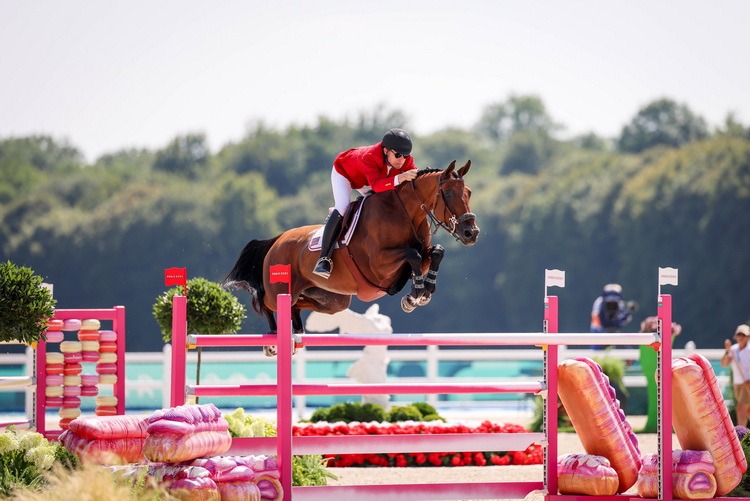
The vinification fence complete with grapes and wine barrel (it’s in our lead photo being jumped by McLain Ward) is a tribute to the country’s wine industry. There was a fence flanked by the Statue of Liberty (a gift to the U.S. from France) and its torch; the Eiffel Tower (of course!), a wall crafted to look like the stained glass at Notre Dame, and seaside cabins (we would call them cabanas) in a nod to the country’s popular beaches.

The US, British and French teams with their medals. (U.S. EQuestrian Photo)
Laura, 58, who started her Olympic career as an alternate at the 1992 Barcelona Games, has the distinction of being the oldest female U.S. Olympian to medal since an archer who competed in 1904. When it’s brought up, she laughs about it. Laura is a good sport. Anyway, she wasn’t the oldest in the class. That was Rolf Goran-Bengtsson, who is 62. It’s wonderful that riding is such a lifetime pursuit!
Jumping returns to Versailles on Monday with the qualifier for the individual medals, but the action continues on Saturday with team dressage at 4 a.m. Eastern Time. Don’t worry about getting up, I’ll tell you what happens. The U.S. does not have a team; it was eliminated earlier this week because Marcus Orlob’s ride, Jane, had a small scratch on her right hind fetlock. No U.S. rider qualified for the individual finals on Sunday.
Click here for team jumping results. Click here for individual results

by Nancy Jaffer | Aug 1, 2024
The U.S. made it into Friday’s Olympic team show jumping competition by finishing second in Thursday’s qualifier, which sorted out the 10 countries that will ride for medals Friday from the 20 entered in that discipline at the Games. Those competing start with a clean slate.
There was intense pressure on the U.S. squad after the country’s eventing team failed to medal in Paris and the dressage team was eliminated. Show jumping is “it” If America is going to get a medal at Versailles (and not go home empty-handed, as U.S. equestrians did from London in 2012.).
In the qualifier, Germany was the only team to finish on 0 penalties. The U.S. had 6 faults; clear rounds by Laura Kraut and last-minute sub Karl Cook, while anchor rider McLain Ward collected 4 penalties for a rail at the tallest jump on the course, a vertical standing 1.63 meters, and 2 penalties for going over the 79-second time allowed.
But McLain had no worries about his performance on Ilex, a horse he has been riding for only a few months.
“I was thrilled,” he said after his trip over the fences in a stadium that was packed with fans, as it has been every day of the Olympics.
“I knew going in we had a pretty big margin of error, so I made a plan to be a little conservative and make sure there wasn’t a big blow-up,” he said.
Of his knockdown at the eighth of 14 obstacles, which had wings commemorating the clock on the Musée d’Orsay, he commented, “It was a very light rub and not a big deal. I think all the team performed brilliantly and look very good going into tomorrow. It’s a whole new competition. The horses feel great.”
He added, “I think it’s not only obviously important `job one’ is to qualify. We don’t want to take that for granted, the sport is strong.”
He pointed out that Sweden’s Tokyo Olympics team gold medalist Peder Fredricson, one of the most experienced riders, on one of the most experienced horses, Catch Me Not, had a run-out at the spooky-looking Graffiti Wall fence, so nothing is a given. (Luckily for Sweden, its pathfinder, World Number One Henrik von Eckermann, was fault-free on King Edward.)
Henrik observed, “I always think the first track is the worst one because you’re not really sure. I mean, I know my horse very, very well, but still, you never know — it’s animals, not machines, and you just want to have a good feeling, and you don’t know how it is going to be before you do it.”
What’s important to consider for the U.S. in addition to faults, McLain said, is “How did the horses feel? They felt fresh and jumped well. The time wasn’t super tight today. I made the time always with him, I didn’t put a lot of concern on the time. I didn’t want to have too many (time faults) but there were a couple of places I took my time, especially at the end.”
Karl, riding Caracole de la Roque, had been the alternate but was called off the bench when an alllergy-related question arose about team member Kent Farrington’s Greya. With no drop score under Olympic rules, the team couldn’t take any chances on a horse who might be sub-par.
And the pinch-hitter was ready for his big moment.
“It was very clear, obviously, that I was the alternate, and very clear how late I could be called,” pointed out Karl, who had everything packed and was ready to ride if needed.
“We knew that going in, so it was important to act, all of our prep, everything, last night, this morning, was as if we were showing, because it’s too hard to do that after the fact. We were on the team the whole time, mentally.

Karl Cook and Caracole de la Roque at the macaron fence. (US Equestrian Photo)
He added, “I’d be lying if I said it was easy, but that’s what you’re here to do. It’s not supposed to be easy, it’s supposed to be challenging, it’s supposed to test you, and I’m just so appreciative for the opportunity. I feel proud that I could do that for team USA and my other team members.”
Admitting there was a feeling of pressure before his round, he noted, “Once you pick up the canter, then everything kind of just goes away. I don’t have enough mental ability to do both of those (worry and ride), because it takes so much focus.”
Of his Selle Francais mare, one of the fastest horses in the world, he commented, “She loves this. This is all she loves to do. She gets so excited; I would say she’s zero percent stressed and 100 percent excited.”
He noted with a smile that attitude gives her an edge over her rider. Interestingly, he does most of the warm-up in a different bridle than the hackamore she wears in the show ring.
Laura acknowledged the pressure, saying it was a relief to have produced a perfect trip with Baloutinue, the only horse on the 2024 squad who also competed at the last Games in Tokyo, where the U.S. earned silver.
“I wasn’t 100 percent sure what my plan was going to be,” Laura admitted, “because, to be honest with you, the course wasn’t really suited to him, but going first I just thought I’ve got to go in and be quick, since time is going to be such a factor, and just have faith that he’ll clear the fences. And he did!
“It was pretty nerve-wracking before I went in,” said Laura, who had support from her partner, Nick Skelton, winner of individual gold for Britain at the 2016 Games in Rio.
“It’s never a low-stress event at the Olympic Games,” Laura observed.

Laura Kraut and Baloutinue. (U.S. Equestrian Photo)
Discussing the route designed by Spain’s Santiago Varela and Gregory Bodo of France, she said, “The course was very technical and big. Bodo is a brilliant course builder. I’ve been jumping his courses quite a bit lately. He has a way of sneaking in things that are far more difficult than they appear to be, as he’s done today.”
The course certainly was beautiful, with themed fences including a combination where the most faults were incurred, the Olympic triple of medals and an image of Olympics founder Baron Pierre de Coubertin (wonder what he would have thought of the opening ceremonies); L’Opera, complete with paintings of comfy theater seats on the jump standards, a water jump honoring French oceanographer Jacques Cousteau and a triple bar with a Champs Elysee street sign.
“I’m just very fortunate I have an absolutely amazing horse. He was in the zone and he was on it,” Laura said.
“The water (jump) is quite big, it’s going away from the gate it comes on a bit of an awkward angle and I think some of the horses aren’t quite getting up to the front of it as much as they’d like. Even my horse landed shallow a little bit.”
She also noted the third fence, topped with a gray plank, is difficult and hard to see. Her horse touched it, but luckily it stayed up.
“There’s a lot out there,” Laura observed.
Karl had noted that course designers these days are “playing with color” (the candy-striped rail at the macaron and pastry A element of the double and the pink rail in the middle of the triple came to mind when he said that.) He mentioned it’s hard for both horse and rider to focus on those kinds of poles.
“So making it harder makes it more careful, and that’s what increased the difficulty without having to make it massive,” said Karl.
“It’s a good way the sport is going.”
Laura had only been riding Baloutinue for two months before her last Olympics and hardly knew him at all, but now she has had time to build a partnership.
“It’s really comforting to come here this time knowing the horse. He trusts me and I certainly trust him.
“He has it all, he’s got personality in the stables. When you get on to ride him, he’s all about the business. He’s brave, careful and scopey. That’s kind of what you need when you go to the Olympics.”
“I felt completely confident that he could go in there and do it today,” Laura noted.
He walked into the ring, looked around and saw his fans.
“Even he was excited about it,” she said.
“I think he thought, this was it.”
Coach Robert Ridland was understandably proud, saying, “Our team jumped really well today and executed our first goal of qualifying through to the team final.
“We have another day, though, and need to be prepared for a tough day of competition tomorrow. We obviously had a change to the team this morning, putting Karl and Caracole into the line-up and they really stepped up to the plate for us in a big atmosphere. Laura and Baloutinue are veterans and set the tone with a clear round right off the bat. Karl and Caracole have been on a hot streak and rode a well-executed round for our second clear. McLain and Ilex are looking strong and the entire team is feeling ready for tomorrow’s final.”
The other teams that qualified were Britain, Belgium and the Netherlands, all with 8 penalties. Ireland, favored by many to win the team title, collected 9 penalties to wind up sixth after Shane Sweetnam had a rail with James Kann Kruz and anchor Cian O’Connor dropped the pink rail at the B element of the triple combination with Maurice. Cian also had a time penalty. The third team member, Daniel Coyle, was fault-free with Legacy.
France and Sweden had 12 and 17 penalties respectively, while Israel and Mexico wound up with 20 each to round out the starting list for Friday. Switzerland, usually one of the strongest countries, failed to qualify, finishing twelfth.
Ties were decided by which country was fastest. The U.S. was faster than the others, but that didn’t matter because it was the only one with 6 penalties so a tie did not have to be broken. But speed ability could be handy when it counts for the medals on Friday.
McLain’s buddy Richard Vogel of Germany rides the spectacular United Touch S and is among those touted as an individual medal possibility. But before that, he’s thinking about his team.
“All riders performed well today. I think all three German rounds were smooth, so that makes us optimistic for tomorrow. But we’re also aware that it starts from zero, and besides a good starting position there’s not so much achieved yet – we will see,” he said.

Defending Olympic individual gold medalist Ben Maher of Great Britain and Dallas Vegas Batilly after their clean round. (Photo Jon Stroud Media)
Britain’s defending individual gold medalist Ben Maher made an eleventh-hour swap out of Point Break and put in Dallas Vegas Batilly. Point Break is only 10 years old, and Ben felt with the atmospheric venue and the heat, he needed a horse with more mileage.
“Experience will carry us forward,” he said, noting that as his mare continued her round, “She grew in confidence and really found her feet, so to speak.”
“That was a great start and it’s good just to get going; to be honest, there’s a lot of waiting around and not knowing what’s coming on the first round, but it’s a big enough test today and Dallas Vegas was listening and really on point for me,” Ben commented.
Click here for results.
by Nancy Jaffer | Aug 1, 2024
Concern over the condition of Kent Farrington’s mount, Greya, has led to swapping that combination for alternate Karl Cook and Caracole de la Roque on thee U.S. team before show jumping got under way at Versailles Thursday.
“There is a small question mark with Greya, which is allergy-related, and erring on the side of extreme caution and with the no drop score in the format, we have made the decision to bring in Karl Cook and Caracole de la Roque,” said Coach Robert Ridland.
Karl and his mare were second to Kent and his mare in the La Baule grand prix in France in June, and Karl went on to win the Rolex Grand Prix of Rome.
The pressure is really on the show jumpers to deliver for the U.S., as the eventers fell short of a medal and the dressage team was eliminated.