by Nancy Jaffer | Sep 13, 2026
It looked as if the quest for the Rolex Grand Slam was all over for world number one-ranked show jumper Richie Vogel, when United Touch S clipped a rail from the next-to-last fence in the second round of the world’s richest grand prix Sunday, after the pole splashed into the liverpool beneath it. The German’s disappointing score was 4 penalties.
But then the next rider to go in the 12-horse second round in Calgary, Alberta, Canada at the Spruce Meadows Masters, Ireland’s Daniel Coyle on Farrel, had two rails down from that dangerous double, leaving him on 8 penalties. And the final competitor, Lillie Keenan of the U.S., toppled the B element of the CPKC double with Fasther.
So all was not lost for Richie, because Lillie’s error triggered a six-horse tiebreaker of the 4-fauters from six nations, all that remained of the starting field of 39 in the $5 million (Canadian) CPKC International Grand Prix presented by Rolex.
The original group, which included seven of the world’s top 10 jumper riders, was whittled down to 12 for the second round. That involved the seven fault-free competitors, one rider with a single time fault, and the four fastest 4-faulters. All faults carried over from the first round to the second round and then the tiebreaker, which is why there was no participant with a totally clean slate, unsullied by penalties. Last year’s class, won by Great Britain’s Scott Brash, also featured a jump-off of 4-faulters, but there were only two of them in 2025.
World Champion Steve Guerdat of Switzerland led the way in the jump-off for this year’s edition of the class on a fast, fault-free trip in 42.25 seconds with Albfuehren’s Iashin Sitte. That put his total for the day at 4 penalties, counting his knockdown in the first round.
Steve was followed by Great Britain’s Ben Maher on Enjeu de Grisien. Ben was injured in a fall from a different horse in Saturday’s Nations Cup, but bounced back despite a broken right collarbone to take his chances in the featured class — even though his wife, didn’t want him to compete. Perhaps he shouldn’t share the $1.5 million (Canadian) first prize with her…

Ben Maher and Enjou de Grisien. (Rolex Grand Slam/Ashley Neuhof)
His perfect jump-off trip was clocked in 41.40 seconds. In the end, it would be good enough to win when added to his 4 faults from the first round, but not before four more riders had their turn. One of them was Richie.
Sadly, his second chance of the day at getting the 1 million Euro bonus for the Grand Slam did not work out, with the B element of the CPKC double hitting the ground on the shortened course designed by Leopoldo Palacios and Anthony D’Ambrosio. Not only did the European champion lose the class, finishing fifth, he also lost a chance to claim the elusive Rolex Grand Slam, which has been won just once.
That was 11 years ago; no one since Scott did it in 2015 has been able to win three Rolex Major grands prix in a row to claim the title. Scott, number three in the world, finished seventeenth on Sunday after a slow 4-fault trip in the first round on Hello Jefferson.
Last to jump in the tiebreaker was Lillie, who gave her aptly named mount, Fasther, a kiss on the neck before heading out on course.

Lillie Keenan at the iconic Dutch bicycle jump from the 1994 World Equestrian Games in the Hague.
Having knocked down a pole in the second round, she returned to be fault-free in the jump-off, but was 0.45 seconds slower than Ben. That put her in the silver medal spot on the podium. Not bad — she was sandwiched in the standings between two Olympic individual gold medalists. (Steve was 2012; Ben 2021).
“I am a little disappointed in myself,” said Lillie, always the perfectionist, blaming herself for her rail in the second round.

Ben Maher with Lillie Keenan and Steve Guerdat on the podium.
“I know my horse could have won today, but I am extremely proud of him,” she noted about the 16-year-old KWPN gelding she has worked with for eight years.
“It was a long day, hard-fought, but to be second to Ben Maher is pretty awesome.”
The class took nearly five hours to run, on a day that included the region’s first frost of the season and a dose of rain. But the stellar level of competition made it sparkle for the crowd wrapped in blankets, parkas, scarves and hoodies who filled the stands around the immaculately prepared grass field.
“Incredible day,” said Ben as he absorbed the fact that he had triumphed after three grueling rounds.
“I’ve been coming to Spruce Meadows for many years; never had too much luck in the grand prix. Enjeu, he’s always loved this arena, but never had a chance on Sunday. I thought the chance had slipped away with the one down (in the first round.”

Ben realized a longtime dream with Enjeu when they won the CPKC International. (Photo courtesy Ben Maher)
“I came back around and I got a second chance and he did everything for me,” Ben continued, praising his 12-year-old Selle Francais.
“This sport, one day you’re on the floor; the next day you could be winning. It was an unfortunate mistake yesterday (Saturday) and i paid for it. It was a long night; I came very close to not riding today. I’m very happy we won.”

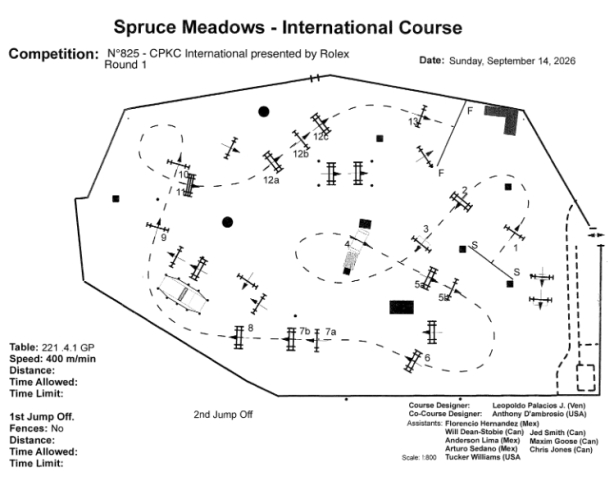
The first-round course for the CPKC grand prix.
U.S. Coach Robert Ridland noted Lillie “Just barely missed winning the grand prix. She’s a fierce competitor ever since she won the Maclay finals quite a few years ago. She’s a tremendous talent.”
What was his reaction when he saw the scoreboard timer after her ride?
“My first thought was probably what her first thought was: Damn — she almost won. She’s out there to win, not to be second. I thought she had him. She rode exactly the ride they planned going in,” he said, referring to her mentor, McLain Ward, who finished twelfth on High Star Hero. Lillie noted McLain was with her “every step of the way.”
“She got fairly beaten by a great ride,” Robert added graciously.
“She laid it down just like she wanted to — to be second in the biggest prize money event in our sport is not too shabby.”
Reflecting on how the class went, Lillie felt in the jump-off, “I should have been faster to the third jump. I left out a stride from one to two, which was my plan.
But then, she noted, “I didn’t push through the rollback.” Her horse, she added, was “phenomenal.”
The silver medal winner noted, “I am incredibly grateful to the team around me, because I show quite a bit, and to have any success at this level is thanks to everyone behind the scenes who makes it possible.” Click here for results

by Nancy Jaffer | Sep 12, 2026
The conclusion of the BMO Nations Cup at Spruce Meadows Saturday was not really a surprise, as the German team built on the world show jumping championship it won last month in Aachen to take another splendid victory.
The squad’s talent translated across the Atlantic Ocean to Canada, where Germany finished on a mere 4 penalties to take the BMO Cup for a record twelfth time.
But the other podium placings were in doubt until the end, while the action offered its share of unexpected drama throughout the afternoon.
In the first round, defending Cup champion Great Britain led on 2 penalties, with Germany second on its 4, Ireland third on 8 and the U.S. fourth on 16. But things did not go Britain’s way in the second round, and the unsettling climax was 2020 Olympic individual gold medalist Ben Maher’s fall at the first fence, after Catelly ran through it. Happily, neither horse nor rider was injured, but it was a shocker for the crowd lining the berms and grandstands around the vast turf field in Calgary.
Britain wound up fourth on 26 penalties, behind Ireland, which rose to second with 17 penalties from fourth after the first round, and Belgium, fifth in the first round, but going on to claim the third podium spot on 21 penalties.
The U.S., fourth in the first round, ended up fifth on 46 penalties without a fault-free trip during the afternoon. Anchor rider McLain Ward did not take part in the second round, because anything he did could not improve the team’s placing. A total of nine teams took part in the first round, with six qualifying for the second round over the same course.
Another surprise was seeing Germany’s anchor rider, world number one and European Champion Richie Vogel, ride Cloudio in the second round after his country already had clinched the title. Why bother, you ask.
The answer: Although he already was fault-free in the first round and the team didn’t need another score from him in order to win, a second clear would boost his points in the world standings. It was not to be, however, since a rail at the last fence, the Swedish butterflies oxer over a liverpool, came down.
It made no difference in Germany’s score because Richie’s teammates, Sophie Hinners, Daniel Deusser and Jörne Sprehe, all were fault-free in that round, and only the best three scores count. The team was the same as the victorious Aachen squad, with the exception of Jörne subbing for Marcus Ehning.

The winning German team with Chef d’Equipe Otto Becker: Jörne Sprehe, Daniel Deusser, Sophie Hinners, Richie Vogel. (Spruce Meadows Media/Dave Chidley)
“It was a tough course,” said German Chef d’Equpe Otto Becker, a comment echoed many times as the class proceeded.
“I’m totally proud and happy. It’s something special to win here at Spruce Meadows,” Otto concluded.
The course was laid out by Spruce’s perennial designer, Leopoldo Palacios, who had a doozy of a test on the line from fence nine. the oxer painted in Ireland’s colors, four strides to the blue and white vertical/oxer/vertical BMO triple combination, with one stride between its elements.

The “tough” course.
In the first round, that line was responsible for 22 faults, and some involved more than just falling rails.
Britain’s pathfinder, Jessica Mendoza — who had only 4 penalties in the first round when a block toppled from the Normandy wall, fence number two — assessed the scene after watching other competitors ride. It took 18 trips until Sophie Hinners scored the first double-clear.
“It’s clearly a tough course,” Jessica said.
“It was a little bit of a bloodbath out there.”
The home team suffered the worst luck.
Nikki Walker had the B element of the triple down, and then a refusal at C. When she came back, she fell off as her horse refused in the combination.
Prior to that, Kyle King, a dual U.S./Canadian citizen making his debut on the Canadian team with Kayenne Z, crashed through the famous Dutch bicycle fence, then had a difficult approach to the next jump, turned away and left the ring after the horn blew.
With only two members remaining from the four-member squad, Canada was out. Although Amy Millar did start, she had a refusal at the triple and retired.
“It sure wasn’t our best day,” said chef d’equipe Ian Millar, who rode on many winning teams at Spruce Meadows.
“Reasons are excuses and so you’re not going to get either from me. I’m just going to say our horse/rider combinations weren’t good enough today and we’re going to fix it in the future.”
Discussing the course, the 10-time Olympian said, “I think the triple BMO combination today caused an unintended amount of trouble.”

Richie Vogel and Cloudio mastered the BMO triple.
Citing the grade of the ring’s surface, he commented, “the horses are actually working their way up a hill. It was a visual and it was a bit of distance issue and horses just didn’t figure it out. The second round, they came back, and by and large, jumped it so much better because they knew what it was at that point.” Click here for results
The excitement isn’t over at Spruce Meadows. The world’s richest grand prix, the $5 million (Canadian) CPKC ‘International’, presented by Rolex, is slated for Sunday. Richie Vogel is in line to become only the second person to take the Rolex Grand Slam if he can win the class.
The format of the Rolex Grand Slam of Show Jumping is simple: anyone who wins three major Rolex grands prix in a row receives the Rolex Grand Slam trophy and a 1 million Euro bonus on top of the class’s prize-money. If that same rider then continues their success by winning a fourth Major in succession, they will be rewarded with an additional 1 million Euro bonus.
by Nancy Jaffer | Sep 8, 2026
Equine pain management — that’s always a hot topic. It’s something that’s too often the subject of rumors and gossip, with facts going by the wayside.
For what you really need to know about the subject, listen via Zoom to the latest episode in Cornell University’s Equine Seminar Series.
“Equine Pain Management: From the Farm to the Operating Room to the ICU” will be the subject Sept. 15 from 6-7 p.m.
Dr. Jordyn Boesch will discuss strategies, from systemic medications to advanced regional anesthetic techniques used to manage acute pain in horses
The event is free and open to the public, but it requires registration at this link.
Dr. Jordyn Boesch is an associate professor of anesthesiology and pain medicine in the Department of Clinical Sciences at Cornell. She is also an adjunct associate professor at New York University, where she collaborated on research on the neurobiology of pain. She established the multidisciplinary, collaborative Cornell University comparative pain program to further clinical service, research, and education in pain management.
When on duty in the equine hospital, she leads a team of staff in the provision of anesthesia and analgesia to equine patients, including continuous infusion of analgesic medications, epidural injection/ catheterization, peripheral nerve blocks, and neurolytic procedures. She also coordinates an elective course for third-year veterinary students entitled Animal Pain.

by Nancy Jaffer | Sep 8, 2026
Air vests have grown exponentially popular among riders, seeking a way to protect themselves if — or rather, when — they fall off.
Trainer Jimmy Torano began wearing one after his friend and client, Daryl Portela, was badly injured in a 2020 fall.
A year after Daryl’s accident, Jimmy recounted, “We had talked about her wearing a vest and it never materialized and she had that bad fall and I said, `We’re ordering them.’ From that day forward we wear them in every class.
“In the old days, we didn’t wear seat belts, we didn’t wear helmets,” Jimmy pointed out.
Now, of course, we can’t imagine life without those items.
“Change is hard. This is my choice. Everyone’s got to make their own decision, and this is mine,” Jimmy said.
It also has been the decision of many others. A prominent example is Laura Kraut, an Olympic medalist and high-profile regular on the U.S. show jumping team, whose omnipresent vest is visible in the way it blends with her jacket.
While some riders may feel safer with a vest, U.S. team physician Mark Hart pointed out there are pertinent questions about them that have yet to be answered.

Every rider can fall, even the world’s best.
He chairs the Equestrian Safety Vest Working Group, which is doing much-needed research on the subject.
Dr. Hart spoke recently during a U.S. Hunter Jumper Association Town Hall, along with Dr. Michele Hollis, chair of USHJA’s safety committee.
Many are “wondering what data is behind this? Are they (the vests) really safe? What injuries do they prevent?” Hart said.
The working group wants to create something similar to the Virginia Tech helmet rating system, which would help people make educated judgments about buying a vest. At present, there are no international certification standards for safety vests, unlike the situation with helmets.
“We need real science, we need real data. It does not exist,” said Hart.
“We have to go back to square one.”
However, as he noted, “It soon became apparent this wasn’t a U.S. problem; it was a worldwide problem.”
For that reason, he pointed out, it made sense to think internationally and have the FEI create the Equestrian Safety Vest Working Group.

Jimmy Torano’s son, JJ, wears an air vest.
The 12-member scientific panel of international experts includes not only physicians, but also biomechanical engineers and representatives from other disciplines and sports, such as horse racing, downhill skiing and motocross, along with some biomechanical experts involved in automotive safety.
There are several focus groups; for instance, a rider advisory panel surveys why riders wear a vest, or why they don’t, and deals with their concerns. As Hart noted, issues with the vests could be that they don’t allow a sufficient range of motion, or that those wearing them can’t tuck and roll in a fall because the vests inflate (which is the point of any protection they provide).
The manufacturers’ focus advisory group includes people who have technical expertise as to what they can produce, and what they can’t.
Hart noted different national federations around the world are helping obtain vital information. The scientific panel had input from other advisory panels about what knowledge will be needed.

Laura Kraut’s safety vest is visible in this photo.
A first step for research is “getting a very comprehensive video analysis of falls and what actual injuries are happening worldwide,” according to Hart.
Eventing, a discipline in which cross-country falls are a regular occurrence, has the best data base; the hunter/jumper sport doesn’t have it to the same degree, Hart pointed out. The videos are vital because they can be used to create computer models showing the forces involved in falls and what particular injuries result.
Serious falls are a rare event, so researchers have to learn as much as they can with data from those incidents. A drop box is being established where videos depicting falls can be deposited. All information will be kept anonymous. Hart urged widespread participation.
“We all as members can contribute to this project to make everybody safer and help our sport.”
That’s especially crucial in the atmosphere of social license to operate that has the public’s eye firmly fixed on what happens in equestrian sport.
Hart notes several research papers about the effects of vests are contradictory or did not reach a conclusion. An independent audit from the FEI found fence-related factors account for less than 10 percent of the variability in horse falls.
A wider analysis from the University of Melbourne and the University of Sydney found that riders wearing air jackets had 1.7 times the odds of serious or fatal injury — with the authors explicit that causation was not established and confounders were likely.
According to a 2016 crash study, air jackets reduced predicted severe chest injury risk from 94 percent to 81 percent, while still concluding fatal injury remains highly likely when a horse lands on a rider.
“When we’re dealing with a 1,000 kilogram animal at speed, at heights, we are not going to make this 100 percent safe; just like we drive cars every day, there’s going to be accidents,” Hart pointed out.
“But can we reduce the severity of the injuries when a fall inevitably happens?”
It is not only air vests being examined, but also traditional foam body protectors, which eventers wear under their air vests.
“It’s going to be an incremental process. We’re always going to be working to make riding safer for the horses and the athletes. Are safety vests going to help everything? No,” Hart said.
But there are other things that can be done in the interests of safety. In terms of decreasing severe injuries, with more than protective gear to be considered. Hart noted a number of factors involved with prioritizing prevention, including Minimum Eligibility Requirements for riders and horses before moving on to the next level, as well as focused training and in eventing, frangible fences that fall when struck by a horse’s hooves or legs.
Questions or comments on the subject can be directed to medical@fei.org

by Nancy Jaffer | Sep 6, 2026
The honor and self-confidence of Gemma Stevens were reaffirmed in dramatic fashion with a fault-free show jumping effort Sunday aboard Chilli Knight at the Defender Burghley Horse Trials, capitalizing on her cross-country lead to claim top honors.
The victory was special for more than just the obvious reason, which is having a British rider win a British event — one that is regarded as the world’s most difficult 5-star.
But it also came just three weeks after Gemma was eliminated at the FEI World Championships in Aachen following three cross-country refusals with Flash Cooley.
Gemma, 41, was a member of the British squad that won gold at August’s title meet, but her effort was the drop score under the formula where only the best three totals count. She called the experience, understandably, one of the lowest points in her career. Although she was able to stand on the podium at Aachen with her teammates, she felt “horrendous” guilt at her personal outcome.
The new champion, who won her first 5-star at Bicton in 2021, proudly was able to finish Burghley on her dressage score of 29.6 penalties. Just one percent of competitors in the last 20 years have finished on their dressage score at Burghley, according to EquiRatings, and Gemma’s winning margin was the biggest since Blyth Tait’s in 1998.
Gemma wound up with a huge distance between her and her compatriot, second-place Katie Magee and Treworra, who added a rail and time penalties in the final phase, to end on 43 penalties.
That edge would have enabled Gemma to topple three rails and incur time penalties if required to gain the victory. But she needed nothing of the kind as she wrapped up a stellar competition for herself and “Alfie,” a son of the great Chilli Morning. Alfie is out of King’s Gem, the mare on whom Gemma started her 5-star career in earnest.

Gemma and Alfie were popular winners.
Considering her achievement, Gemma said, “This represents 25 years of work and finally I have managed to win a ‘big B,’ ” meaning Burghley or Badminton.
“We so nearly won Badminton a couple of years ago, and I have just known in my heart of hearts that there was a big win in this horse. We just needed our stars to align, and everything has aligned this week.”
She received her trophy in a presentation from the 1971 winner, Princess Anne.
New Zealand’s Tim Price, number one in the world, toppled from second after cross-country to eleventh overall on Global Quest after dropping a rail at the second fence on course, then incurring knockdowns in the double and triple combinations. His 12 faults put him on a score of 48.9 penalties.
The top U.S. rider was Caroline Pamukcu, third with HSH Blake after dropping a rail at the first fence in the show jumping to wind up with a score of 44, one penalty more than Katie. Caroline was the best-placed Burghley first-timer in the competition, and the first American to make the Burghley podium since 2012.

Caroline Pamukcu and HSH Blake. (Libby Law Photo)
She also enjoyed a reclamation of her own, because she had been in a similar position to Gemma at Burghley, since Blake stumbled at a fence during the cross-country at the world championships and her subsequent fall eliminated her. But she still was able to stand on the podium in Aachen with her country’s bronze medal contingent.
The only other U.S. rider to complete Burghley was another world championships bronze medal team member Will Coleman, fault-free in jumping with Very Dignified, but slow on cross-country to end in a very respectable seventh place (47.2).
“For me, Burghley is the ultimate in our sport, the crown jewel of 5-star eventing. It’s the ultimate test. It’s a wonderful place. It’s like riding in a fairy tale and I can’t wait to come back,” said Will, adding, “But 2026 has treated me well.”
He won the Avebury trophy for the best cross-country round, as judged by two-time Burghley winner Pippa Funnell. That’s pretty special, especially considering it was the mare’s first 5-star.

Rosemary Barlow presents Will Coleman with the Avebury trophy, named in honor of her three-time Burghley winner, ridden by Andrew Nicholson.
Jennie Brannigan had been in twelfth place after cross-country with FE Lifestyle, but the horse was held, then spun, at the final horse inspection.
“Unfortunately, he pulled his bell boot off before the Trout Hatchery (obstacle 19 on cross-country) and has an over-reach on the inside and outside of his right front,” said Jennie.
While the ground jury did not pass him, Jennie emphasized the bright side: “most importantly, he is just fine.”
A total of 26 horses finished the event, from a starting field of 48. The other horse who didn’t make it to the end on Sunday was Benedict Radau, ridden by Matthew Heath of Great Britain, who was eliminated after knockdowns and a refusal in show jumping.
Switzerland’s Nadja Minder, the leader after dressage with 19-year-old Toblerone, finished fifth with a single knockdown atop the oldest horse in the competition.
Was this his last 5-star? The rider won’t commit, giving an “age is just a number”-type reply to the question. She explained any such decision should be made on what the horse wants to do, as opposed to making it based only on age.
A highlight of the day was the retirement ceremony for 19-year-old Ballaghmor Class, who got a standing ovation from the crowd. Many tears were shed at his farewell.
The Irish-bred gelding made Burghley the first of his four 5-star wins in 2017, and went on to win it again in 2023. He also was on the 2021 gold medal Olympic team.
“Kids have dreams and because of him, my dreams came true,” said rider Oliver Townend, who considers the horse he calls Thomas his best friend.
“Burghley is part of me. I first went there as a two-year-old when my dad competed as an amateur in 1984. It is something that has been a very important part of my life, the most special event you can win,” noted an emotional Oliver.
Click here for final results

by Nancy Jaffer | Sep 5, 2026
How fast things change in horse sport.
Just last month, Gemma Stevens was mourning having wound up as the drop score for Britain’s gold medal eventing team at the FEI World Championships in Aachen, Germany, after being eliminated for three refusals with Flash Cooley.
On home ground Saturday, it was a far different story, as she took the lead aboard Chilli Knight at the Defender Burghley Horse Trials. Going into Sunday’s stadium jumping, she stands on her dressage score of 29.6 penalties after finishing cross-country three seconds inside the optimum time of 11 minutes, 20 seconds over the route laid out by American Derek Di Grazia.
After her world championships experience, where her “dreams were completely crushed,” she said, “it is really hard to pick yourself up. But I just thought ‘Do you know what? I am coming here with this little boy — get on with it.’ ”
Reflecting on her round aboard the horse she calls Alfie, Gemma added: “It felt like a rollercoaster. It [the course] just felt like you were constantly climbing or going downhill, turning the corner to another humungous fence. It was so relentless.
“I kept being down on my minutes, and I was like ‘Oh, no, I am never going to get the time’. Then I managed to claw it back, and then I was down on the next one, and then I clawed it back again, and I went round the whole course like that.”

Gemma and Alfie below the Lion Bridge. (Defender Burghley photo)
Second after dressage concluded on Friday, she now has a great shot at the winner’s prize of £120,000 ($162,000). Gemma got a figurative leg up to that position from Piggy March, who won Burghley four years ago on Vanir Kamira.
The help was in the form of a voice message from Piggy, who advised in no uncertain terms, “get out there and get on with it.”
Gemma didn’t need to be told twice.
“I do always get out there and want to get on with it, and that is what you have to do,” she summed up.
The finale will pose a challenge from world number one, Tim Price of New Zealand. He had been touted as a possible winner with Falco, but retired that horse after a refusal at the hanging log in the Trout Hatchery, the nineteenth of 28 obstacles.
Instead, he stands second with the less-decorated Global Quest, an Irish sport horse stallion who stepped up to the big time in a big way.
“There was a lot of learning to be done here,” said Tim, calling his mount “an authentic 5-star horse.”
He is riding Global Quest in honor of the late Georgie Campbell, who developed the horse and then died after a fall while riding him at the Bicton Horse Trials in Britain in May 2024.
Sixth after dressage, Tim was promoted to second on 36.9 penalties, his dressage score plus 4.8 for time cross-country, after taking a long route at the Leaf Pit obstacle. His total means Gemma can afford to have a rail down and a few time penalties in the jumping phase with her stallion, a son of the great eventing sire, Chilli Morning.
The top American in the standings is Caroline Pamukcu, who is fifth with her world championships mount, HSH Blake. Like Gemma, Caroline had a major disappointment at the championships. She suffered a fall early on cross-country when Blake stumbled and they were eliminated. But as is often the case with this determined rider, she came back strong.
Caroline added eight time penalties to her dressage score of 32. Without the time overage, she would be second.
With her other mount, HSH Tolan King, Caroline was in the unenviable position of being first to go on cross-country. But her horse jumped the string and left the track at the Trout Hatchery, so she retired.
Next-best for the U.S. was Jennie Brannigan with FE Lifestyle, making the big leap from seventeenth after dressage to twelfth, carrying 11.2 time penalties for a total of 47.2. Right behind her was Kentucky 5-star winner Will Coleman, this time with Very Dignified, dropping from ninth after dressage to thirteenth with 14 time penalties and a total of 47.2.
Nadja Minder, the Swiss overnight leader from dressage with the graceful and aptly named chocolate-colored Toblerone, moved down to sixth place with 13.2 time penalties. The horse is the oldest in the field at age 19.
“He is such a five-star warrior now, and he helped me out so many times,” she said, reflecting on her performance.
“I wish I had given him a better ride, but it is what it is. You know, he just pricks his ears, looks for the flags, front feet up, back feet up, and on we go. He is incredible. I don’t want to say it’s his last run here because he has been so good in the build-up and everything. He is definitely the horse that has shaped my career.”
She and Robin Godel, the other Swiss competitor, are being coached by Andrew Nicholson, the intrepid New Zealander who first won Burghley in 1995.
At this special venue, Andrew feels, “It is very much about the terrain at Burghley, the constant undulating gently up and down and having to ride between the fences as much as over the fences. You have got to ride a little bit on the seat of your pants from the start to finish.”
With the results of the day, he was proven to be spot-on in that assessment.
Sarah Bullimore and Corimiro, touted as the favorite combo before the event, had been given a 21 percent win chance by EquiRatings, with a 63 percent shot at making it into the top 10. However, they parted company at the last fence, as the rider flew off and the horse galloped through the finish line by himself. Sarah first rode at Burghley 30 years ago, but had never won the event.
Of the 46 who started cross-country, just 28 finished. The others either retired or were eliminated.
Click here for results

by Nancy Jaffer | Sep 3, 2026
The USA’s Kent Farrington has been supplanted from the number one spot in the Longines Show Jumping Rankings by Germany’s Richie Vogel, who is in that illustrious spot for the first time in his career. Yet the spotlight may get even brighter for the European champion this Sunday, if he can win the world’s richest grand prix, the $5 Million CPKC ‘International’, presented by Rolex, at the Spruce Meadows Masters in Calgary, Canada.
Beyond that prize, such a victory means he would become only the second rider in history to take the Rolex Grand Slam, awarded for a series of wins in the Rolex series. More than the distinction, that achievement also carries a bonus of 1 million Euros.
And the number one rider definitely is on a roll. Even Kent’s victory in the $400,000 Longines Hampton Classic Grand Prix with Greya at the end of August wasn’t enough to hold off Richie, a member of Germany’s gold medal team at the FEI World Championships last month.
His performance in Aachen gave him an edge over Kent, who did not go to the championships. And then Richie won the 5-star Brussels Grand Prix with Gangster Montdesir on the same day that Kent triumphed at the Classic. As a result, he gained a 73-point edge over his American rival.
“It still feels very surreal to hear that I am world number one,” Richie said.
“It is a huge achievement and makes me incredibly proud of what we have been able to achieve together as a team. As a rider, I am certainly far from being the best in the world, but I believe this title is a pretty good indication that I have the very best team around me.
Richie Vogel and Ganster Montdesir.
“Both the people and, of course, the horses, by my side have made this possible. There are countless people I am grateful to who have supported the young boy with big dreams and helped me get to where I am today. Every single one of you is part of this achievement.
“A very special thank you goes to the whole VW team, especially to my grooms, Felicia and Gigi. The passion, dedication and care you give our horses every single day is the foundation of everything we achieve.
“And the biggest thank you, of course, goes to our horses. Having superstars like United, Cloudio and Gangster under my saddle is a true honor, but this achievement belongs just as much to the many other horses who stand slightly in their shadows, as well as those I have had in the past who taught me so much along the way. They are what drive and motivate us every single day.”
Scott Brash, part of the British bronze medal team in Aachen and a three-time former Longines Rankings leader, has moved up a place to third on 3,274, with new world champion Steve Guerdat of Switzerland going from sixteenth to fourth.
After Kent, the next-highest-ranked American is McLain Ward, ninth. Laura Kraut is twelfth on the roster.

by Nancy Jaffer | Sep 3, 2026
What a perfect name for a Swiss horse whose coat is the color of a chocolate bar: Toblerone.
The 19-year-old gelding and his rider, Nadja Minder, headed the 5-star Defender Burghley Horse Trials after the first day of dressage with 29.5 penalties. And as the second day wrapped up on Friday, Toblerone still led the way.
The oldest horse in the field has the honor of being the first Swiss entry to head the standings in the 65-year history of the British event.
The combination has been seen regularly on the Swiss team since for five years. They were the pathfinders at the European Championships last year. They were twentieth at Burghley in 2024.
“It was really cool,” said 30-year-old Nadja after her ride.
“Toblerone is a pro now and I just have to make him believe he can do good dressage. When a horse knows its job so well, it is just about getting them fit and supple and Piggy March [the 2022 Burghley winner] has helped me a lot with that.”
Having a Swiss take the lead may provide a bit of temporary solace for the team, which lost a star, Felix Vogg, when his mount, 2025 Maryland 5-star winner Cartania, was not able to compete because of a low red blood cell count.
The favorite, if you’re looking at the odds, is Falco (30.5), the mount of New Zealand’s Tim Price. He is behind British entry Gemma Stevens on Chilli Knight (29.6)
“I am a bit of a sucker for Burghley,” said Tim, who is also aboard Global Quest (32.1), standing sixth. Timm won Burghley eight years ago with Ringwood Sky Boy.
“I love it here, and maybe that comes through, because the horses have been really nice and relaxed,” Tim mused.
“I think everyone comes from a very busy year to this point and we all just take a bit of a breath, other than the very formidable cross-country we have to deal with tomorrow.”
Characterizing Burghley, he said it “has got a grandeur, It is such a lovely place to come, and we are all here giving the biggest competition in the world a go, so there is a real nice honesty here with all the riders and everything.”
Speaking about his longtime partner, Tim said, “Falco has got a really interesting story, because he is missing a few teeth and he has had a couple of issues that have had him on the sidelines over the last few years, but he looks better than ever.”
A tumor in his digestive system meant him taking off six or eight months, Tim pointed out. Another condition meant he had to have his top incisors taken out.
“But he is a good eater, and he would never let that get in the way of a good meal, and he is much happier without them in. He has been an amazing little horse for Sue Benson, who owns him, and I over the last 12-13 years, and yeah, he is just one out of the box.”
The top-placing American in fifth is Caroline Pamukcu on HSH Blake (32). Caroline also is fourteenth on HSH Tolan King (34.4), her ride on Thursday. Caroline rode Blake on the bronze medal U.S. team at the world championships last month, but had a fall cross-country and didn’t finish the course. Hence, Blake’s reappearance at Burghley.
Gemma, a member of Britain’s gold medal team at the championships, was eliminated there for three refusals, finishing her appearance in the title meet as her squad’s drop score. She rode Flash Cooley, a different horse than her Burghley mount.
Will Coleman, another member of the bronze medal team, is the next-highest-place American on Very Dignified, ninth on 33.2.
Other U.S. placings are Britain-based Tianna Coudray, eleventh on D’artagnan (33.8) and Jennie Brannigan with FE Lifestyle (36), seventeenth.
The other U.S. entry is Cassie Sanger with Redfield Fyre (38.2) in twenty-seventh place. .
Click here for results
by Nancy Jaffer | Sep 3, 2026
GRAND PRIX Group, the company that bought the Chronicle of the Horse a year ago, has purchased the World of Show Jumping website. The site has been in existence since 2011.
Vincent Goehrs, president of GRANDPRIX Group. stated, “World of Showjumping has been built patiently on the quality of its editorial work alone, and it is followed today by the world’s best riders and by enthusiasts alike. This is exactly the kind of media outlet whose development we want to support.
“Following The Chronicle of the Horse in the United States, this acquisition allows us to cover international showjumping with a global English-language voice, and to better serve our advertising partners seeking a consistent presence across all the major equestrian markets.”
Only one member of The Chronicle’s editorial staff remains from the time of GRAND PRIX’s purchase. Goehrs said with the website acquisition, however, “The editorial line of World of Showjumping remains unchanged.”
In addition to the Chronicle, the group’s media division now covers French-speaking Europe with GRANDPRIX.info and Studforlife.com, and The Netherlands with Horseman.nl, and international showjumping with World of Showjumping.
“The online media landscape has changed significantly since we started the website,” said World of Show Jumping’s founders, Jannicke Naustdal and Jenny Abrahamsson, as they commented on the sale.
“Over the past couple of years, we have increasingly recognized the need for additional resources to ensure that the website can continue to develop, evolve, and grow.
“We believe this acquisition will provide World of Showjumping with what it needs to reach its full potential, while simultaneously safeguarding the values that have always been at the heart of the website for all the experience and knowledge we have gained along the way.”
by Nancy Jaffer | Aug 31, 2026
An FEI Tribunal panel has determined that Australian dressage Olympian Heath Ryan committed abuse by whipping a horse 42 times in a row during a training session, then delivering blows nine more times, as seen in a May 2023 video.
Ryan, also a three-time Australian three-day event champion, had been provisionally suspended by the FEI in June 2025. A decision in the matter that was released last week stated the suspension would end on Dec. 12, 2026, 18 months after its inception.
The punishment also included a fine of 3,000 Swiss francs, as well as 3,000 Swiss francs in court costs.
Another whipping case that drew attention was the suspension of British dressage multi-gold medalist Charlotte Dujardin, who was suspended for striking a horse with a longe whip in a private training session. She missed the 2024 Olympics as a result.
Calling the Ryan whipping process “constant and consistent,” this month’s FEI decision stated “each strike followed the last with no pause and no hesitation, leaving the horse no opportunity to respond. Even a single whip may be excessive if applied with too much force.”
In his response, Ryan contended the use of the whip was justified because “the horse had developed extremely dangerous behavior. It had attacked and severely injured its owner and placed her in intensive care. The owner had decided the horse should be euthanized unless it could be re-educated.”
The videotaped session was the first occasion on which Ryan rode the horse, describing the animal as being “on the verge of extreme aggression.”
According to an expert report presented to the FEI by Dr. Rachel Murray, the first video shows at least 41 whip strikes, delivered at an average
of 1.3 strikes per second, with only about 0.75 seconds between impacts, “applied with high power by a large rider to the same location, continuously and without allowing the horse time to respond, such that the whipping had no rational training value.”
Dr Murray concluded that the whip was used excessively and as punishment, without release and contrary to recognized learning theory. She also identified “signs of stress, pain and conflict in the horse.”
Ryan responded that he had applied recognized Equitation Science principles, including negative reinforcement with progressive escalation of aids and immediate release upon response. The videos showed only the escalation phase after lighter aids had been given and ignored, and that the assertion in the FEI claim of “no interruption” was inaccurate.
Ryan added the whip was “applied carefully with close attention to timing, duration and release,” and he was “careful not to cross into a fear-state.”
The whip was in his left hand. Ryan noted he was right-handed, contending if he had been trying to hit the horse with strength, the whip would have been in his right hand.
Denying the charges, Ryan maintained the conduct alleged did not meet the threshold of abuse under Article 142 of the FEI’s general regulations, “whether assessed legally, scientifically, or by reference to accepted equine-welfare principles.”
Calling the penalty disproportionate and punitive, he maintained it failed to account for the substantial punishment already suffered through
reputational, professional and financial losses arising from the interim suspension.
Noting he had produced 15 Grand Prix dressage horses over his career, Ryan calculated he had spent a minimum of 1,930,500 minutes training and
competing Grand Prix dressage horses, during which time he had never been accused of abuse, abusive training methods, misuse of aids, horse welfare
issues, or bringing the FEI or the sport into disrepute. The 60 seconds of video represented 0.0000518 percent of the time he had spent riding, training and caring for horses.
Some prominent people in the sport submitted comments in support of Ryan.
Among them was U.S. eventing star Boyd Martin, who trained with Ryan before coming to America from Australia. He made the point that the footage omitted “30 minutes of patient work beforehand and the horse’s compliance at the end. There was no pattern, history or prior complaint.”
Australian Wayne Roycroft, a four-time Olympian and a former chair of the FEI Eventing Committee, stated that he was initially concerned by the video. However, he pointed out the context was a horse that had seriously injured its owner and faced euthanasia. In his view, the video shows Ryan asking the horse forward with consistent aids and no conflicting signals. He noted the horse has since been ridden without incident.
Roycroft, who has known Ryan for 45 to 50 years, was troubled that testimony may have been sought to support a predetermined narrative. He stated that he would trust Ryan with his own horses.
The FEI Tribunal panel that issued the ruling was composed of Canadian Brian Ward, the chairman; Armand Leone of the US. and Yuri Yagi of Japan.