
So what’s next for California’s Desert International Horse Park and its former CEO Steve Hankin, who parted ways this week?
Three partners in the venture bought out Hankin and his wife, Lisa. The couple was the fourth partner in the group that six years ago purchased a long-term lease on 240 acres where the HITS Thermal show had been held previously.
The Desert International Horse Park show will continue, and there are plans for a major expansion and development in years to come at another property just down the road.

Palms and mountains provide the backdrop at Desert International Horse Park. (Photo DIHP)
The break-up raised questions, however, because the show had developed into an incredibly successful fixture, attracting a following not only in the West, but also drawing prominent riders from the East Coast and Europe.
Hankin would say only that, “Whether the partners got along or not is not relevant to the people in the industry. It’s obvious we didn’t and the partnership failed. I think it’s disappointing for the industry that it did. I think what was accomplished in the last five or six years was really remarkable.”
But the details of the break-up aren’t important to those who come to the shows, he pointed out.
“What they care about is that we built something that wasn’t there before, we raised the level of the sport and that we cared about horses,” said Hankin, mentioning he got more than 100 messages after word was out about his departure.
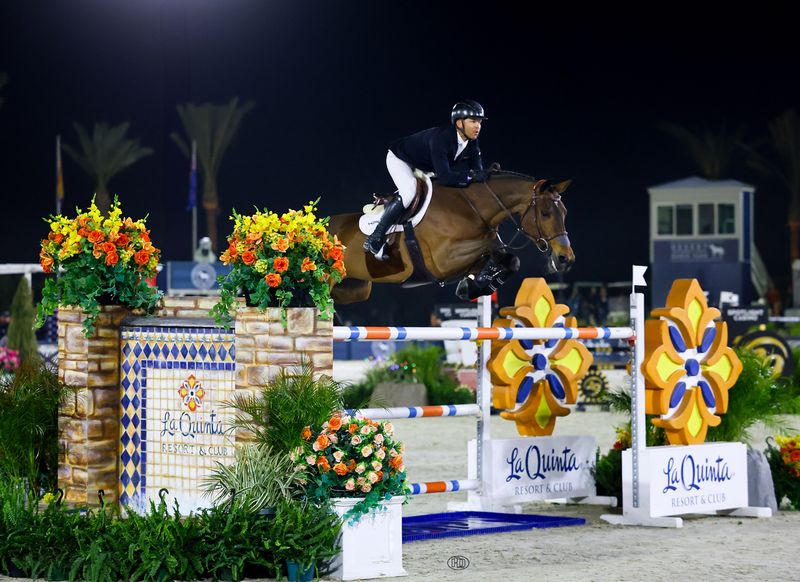
Riders such as Kent Farrington came from the East to compete at DIHP. (Photo DIHP)
Hankin also will be missed by Michael Stone, president of Wellington International, which hosts Florida’s Winter Equestrian Festival.
“I was very disappointed to see he was going,” said Stone.
“He was really a leader to make change and elevate the level in California, which ultimately helps everybody. The higher the level, everybody gets better. You don’t sit on your laurels.
“Having him there was definitely beneficial for the sport in general,” Stone pointed out, noting he and Hankin worked closely when Covid hit.
“We had to come up with ways of being able to get back open as fast as we could. With the EHV (Equine Herpes) outbreak, we worked on that closely too. Good to have a like-minded person on the West Coast really driving the standards out there.”
As for Hankin’s future, he will stay in both the industry and California, his home for 11 years.
“I’m 100 percent not done,” said Hankin, who plans to move on with other projects.
Meanwhile, the remaining DIHP partners, Jeremy and Christina Smith, Rob Meadows and Catherine Harvey, are pursuing a vision of their own on 640 acres that will host the horse show and a development, part of a package called Thermal Ranch. But the show will continue to be called Desert International Horse Park.

It all starts with the leadline. (Photo DIHP)
The new land is being used to grow carrots at the moment and the project is still in the approvals process with the city and county.
“We have no interest in pushing it hard until it’s being built,” Jeremy Smith said about the project, located a short canter from the present facility. The best case scenario would be for the showgrounds to open in October 2029.
“It’s a big project, but we think it’s the future of show jumping on the West Coast,” he continued, adding that it will be 30 percent larger than the current showgrounds.
“We really want to build a permanent home for the horse park that is sustainable, to own your own facility and control your own destiny,” said Smith, who has been in the crafts business and now can add the word “developer” to his resume.
“It’s $100 million to build a show and do it right,” he said, explaining the only way to make the books balance is by constructing homes, hotel rooms and commercial opportunities in and around it as well.
That means “taking a big swing and having a big enough show to make it work.”
He pointed out that while the lease on the current showgrounds is long term, “in 20 years, if it (the land) were needed for anything else, there would be no place to go because development would have happened around it. Where development happens, horses always get pushed out.”
The current facility is aging with “old infrastructure…a hard beast to keep going,” said Smith, who cited all the benefits of a purpose-built venue. The layout for stables and rings will be convenient, and an indoor arena that can host FEI World Cup qualifiers is also part of the vision.
Harvey mentioned that on the current property “The way it’s lined up, you have tractors in the same aisle ways as horses and bicyclists and golf carts We would like to line things out in a much safer way, where those two don’t overlap; have a more efficient use of space and really create a proper center where your grand prix arena and grand hunter arena are and everything else revolves around it.”
That would be “as opposed to our (current) property, it’s (the rings) at one end and the barns are at the opposite ends of the property and the grass field is even at the farthest end of the property.”
The new acreage “would give us more space to do whatever needs to be done,” Harvey said.
As Smith noted, “Being able to build a brand new modern facility that’s perfect for horses as well as guests who can actually come and watch and is safe all around, it will be a breath of fresh air and a dream for all of us.”
Having homes around a showgrounds is a model that started in Wellington, and was done in a more modular way at the World Equestrian Center in Ocala, Fla., and TerraNova, east of Sarasota, Fla.
“We’ve learned a lot over the years and we’re still learning,” said Smith, who envisions people living so close they can take a golf cart over to the venue “and socialize around the horse show instead of just going home at night.”

Socializing is a big part of DIHP’s charm. (Photo DIHP)
The current facility will still be used after the new one is built, but it can have offerings beyond hunter/jumper competition.
Options are dressage, western, low-level hunters and jumpers with no braiding, “the possibility of three day shows with lesser entry fees. How do we lower the bar to have people come in and try it out?” said Smith.
“We’ve got to make it (showing) as accessible as possible, knowing that’s it still expensive,” he commented, pointing out that growing the base is key to keep the sport strong.
The partners aren’t seeking another CEO, but they haven’t made a decision yet about who will be heading up the team at the park.
“I think Steve did a lot and I think asking anyone to do his entire job isn’t necessarily what we want to do,” Smith said.
“We’ll split that up a little bit. There’s enough for a couple of people in there. I’ll take a lot of the business end of it with the team. We all like to be involved in the business. You don’t buy a horse show for an investment, you don’t build a horse park for an investment.
“You do this because you want to be involved in it and you like the business and you enjoy this. We want it to be fun. It’s really exciting for us. But we have no intention of jumping in and running everything.”